#2532: MATrix

Various sports are performed on giant gym mats. These tend to be only liftable by a team of people and thus very hard to stack up at the end of a class.

They rely on their great weight to stay put, although that doesn’t always work (I once broke my ribs on a gym floor when the mats parted during a vigorous tae-kwon-do session (white belt, yellow tab ;).

Today’s invention is gym mats which are only say 1m long and wide. These are small enough to be put away by one competitor.

To avoid them slipping around, due to their light weight, each mat has a recessed groove set into its perimeter.

This allows a rectangular array of mats to be corralled by a strong nylon belt (the buckle of which also fits into the groove, leaving nothing to fall on or trip over).

#2530: PhonEtiquette

Now that business is a global thing, I’m always surprised that local customs and cultural requirements persist so tenaciously.

Today’s invention is a cellphone which can detect which country you have just dialled.

It then flashes up a reminder of the required local etiquette (as detailed here).

#2528: BaGape

Plastic bags are both a boon and a big problem. They are so useful, but so wasteful.

Today’s invention aims to offer bigger carrying capacity using less material.

The plastic carrier bag on the left has some resealable ‘ziplock’ windows moulded into it.

When the bag is loaded, on the right, the windows are opened, allowing weight to be supported by the unperforated bottom section, whilst boosting the overall space in the bag.

Obviously the bag windows can later be resealed and the whole thing reused.

#2527: TravelAgents

Today’s invention is an agent-based model of the fire escape process from an airliner.

The model offers a straightforward way to compare evacuation times for a variety of airliner fuselage and seating geometries. It provides proper 2-D movement simulation (not just linear queueing), with people obstructing/avoiding each other in realistic ways (See this).

The code is deliberately designed to be intuitive to understand (rather than super-efficient at runtime). Despite this, it seems to execute as fast as necessary, even for the largest plane sizes.

If you’d like to talk about how to incorporate this model into your design process, do get in touch.

(This was developed using skills developed on this excellent online course.)

#2526: GoGoad

Many people seems to freeze when an emergency occurs. In a crowded airline cabin, those people also get in the way of everyone else.

Today’s invention is a way to help airline passengers escape a plane.

It makes use of the seat-back screens, together with knowledge of the passengers’ identities and seat numbers.

At the moment when an evacuation is called for, the screens would be switched on and a personal message would appear (this could be agreed a long time previously and just left on the system).

Mine, for example, would use my passport photo and in large print it would say
“Get up Patrick NOW! Leave your stuff and get to an exit.”

This might additionally provide the message verbally (as recorded, say, by my wife).

#2523: Adiabaticar

Consider the heater/air conditioner in a car. It has a lot of work to do in treating the entire volume of air in the passenger compartment.

This all has a cost in terms of both wasted fuel and the time spent waiting for the cabin to warm up or cool down.

Today’s invention is therefore a tightly-fitting blind which is pulled down between the front and rear seats. It would be held in place by slots attached to the walls and floor of the car interior. This blind would be made of insulating material, so that there is very little communication of water vapour or heat between front and back compartments.

The blind could be made with a glass panel to allow continued use of the rear view mirror.

For extreme environments, this might be extended by another blind, isolating the driver from the rest of the passenger cell.

#2521: LabRatory

Theme park owners are desperate for thrilling experiences -which are also 100% safe.

Today’s invention is an upgrade to the ancient idea of mazes, which is aimed at offering eg themeparks a more engaging entertainment.

A large number of tall privet bushes are planted in boxes with wheels, motors and wireless controls.

These bushes can be joined together to form walls of a reconfigurable maze.

Once a ‘player’ has penetrated the maze, cameras detect their eye movements and reorder the walls of the maze in areas where they are not looking.

This could be used to create a genuinely frightening experience…certainly enough of a challenge to those seeking something along the lines of a haunted house visit. The maze could have variations in difficulty, from static to inescapable.

(Cutting the bushes could be done by running them each through a stationary trimmer occasionally).

#2515: CurveAlert

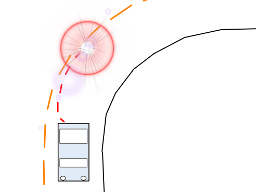
I’ve been driving on country roads this Summer and been unnerved, a number of times, when turning a corner only to find a sudden stationary queue of traffic.

The cars who are coming up behind, but which have yet to negotiate the bend, really need to be warned, somehow.

Today’s invention provides that warning.

A small radio controlled-type car is dropped from the underside of a vehicle, once its hazard warning lights are activated. This would then move about and find the white line in the centre of the road.

It follows the line behind its vehicle until it just loses sight of its home registration plate and then stops. At this point, a bright emergency light on top begins to flash.

Many vehicles might deploy their little robot cars at any point along the road. Each robot would receive a signal from its own car when the hazard lights were turned off. This would be its signal to return to its own car. Those robots that failed to make it back would attach themselves to any passing vehicle. These would incorporate ownership details, so that they could be posted home.

#2512: Roade-odour

When you are out driving, sometimes there are places which smell so bad you wish you’d diverted around them.

That isn’t always possible. though (I’m thinking of a particular landfill site next to a motorway I regularly use).

Today’s invention is a software program which runs in vehicles to help deal with roadside stench.

When anyone drives past such a smell, they can record its location via an app.

A bad-smell map is thus developed.

This is then used by your car, so that a few minutes before you enter a foul zone, the windows close and cabin ventilation automatically switches to recirculation (and might even inject some extra scent into the airflow). This could also take into account known wind direction, so that the switch-on would be optimally timed.