#53: Biscuit freshness measure

Making biscuits for a living is surprisingly hard work. One of the important isssues is how long will the product stay fresh, whether in a sealed packet on a supermarket shelf or once the packet has been opened.

Here’s a way for manufacturers to quantify the freshness of their product as a function of time, humidity, sugar content or whatever.

biscuit96.jpg

It’s well known that the one’s eyeballs vibrate, when crunching food, in ways that the visual system itself can’t compensate for. This effect is made visible when eating a biscuit in front of your computer monitor (generally bad for the keyboard).

The screen image will appear to jump around with an amplitude and frequency largely determined by the crunchiness of the food and the frame rate of the monitor (similar things happen to horn players apparently…Horn players who eat biscuits simultaneously are an endangered species).
#52: Market mathematics

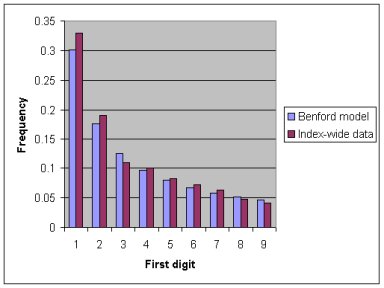
Benford’s Law states that the digits making up numbers in large datasets occur with frequencies which follow a simple pattern and can therefore be predicted. This only applies if the numbers are unrestricted in terms of the range of their values (which certainly applies to stocks…think Wall Street Crash). Numbers beginning with a 1, for example, will occur about 30% of the time.

Today’s idea is to use this phenomenon to get a small edge in stock trading. Specifically, if you are trying to predict movements in an Index as a whole.

benford93.jpg

If all the stock prices in a given market are analysed, the frequency of numbers with different first (ie most significant) digits can be graphed (in purple). These columns can be expected to follow Benford’s law (blue). Here we see that values with 1 as first digit can be expected to be just about to decrease in frequency, whilst those with first digit 8 are can be expected expected to become more common.

A simple sum of the positive and negative deviations from the Benford distribution will indicate whether the index is set to rise or fall.

Applying this technique on eg a daily basis, for a long time, seems to me to provide an edge, which might well be significant compared to the various sources of noise in the system. It’s also likely however to result in large short-term losses which may make the scheme unworkable for anyone other than a very rich gambling addict (As Richard Branson says “How do you become a millionaire? Become a Billionaire and start an airline”).

#51: Colour blindness correction

Having recently heard about someone who was refused a place at medical school due only to his colour blindness, I began thinking of ways to help those of us with an impoverished ability to distinguish between eg shades of red and green (which affects hue discrimination in 5% of all males).

Rather than use (expensive) coloured contact lenses, simply equip colour blind people with a bright pencil torch, over which is fitted a coloured filter. For red/green deficit, the filter could be red so that when viewing a scene containing both red and green items, the red ones would stand out more brightly. The torch could be incorporated into eg spectacle frames for added discretion and also for driving (who thought that making traffic lights red and green was a good idea?)

These days it is possible, given some clever correction for background lighting, to undertake analysis of a digitised scene and to create an ‘augmented reality’ by applying eg a sparkly texture to regions which a normally sighted person would describe as ‘red’. Even a crude version of this, which was able to detect any red and green patches lying close enough together in a scene, could be used to provide an alert.

#50: Paparazzi dazzler

It’s tough being a celebrity, I understand. Even C-list ‘personalities’ are pursued for their photograph these days in the economic war to feed people their daily tabloid fix.

For those females in the public eye who’d rather not make several £k per shot for press photographers, here’s a simple device to bring a scowl to any picture editor’s countenance.

earrings86.jpg

Earrings that project a moving pattern of intense, coloured light patches on their wearer’s face. These could be constructed from LEDs and the swirling patterns generated by small, spring-mounted mirrors amplifying the wearer’s natural body motion (or driven by bluetooth signal from a Blackberry in the handbag -or even vibrated by sound from an earpiece). They might activate automatically in response to the whine of a warming flash, a motordrive, an IR autofocus beam -or just the baying of the snappers themselves.

This would make taking a recognisable photo almost impossible, even for the most determined paparazzo with a flash gun set to stun.

#49: Escher-like cookie cutter

I’m a great admirer of MC Escher. There are numerous possible practical applications of his idea of single-shape tesselations.

The simplest and most obvious is to create a cookie cutter. Not only does this eliminate waste, but if you make one tray of dark and and one of light chocolate brownie, then you can combine tiles from each to create a pleasing (and highly calorific) pattern. Yum.

echerlike80.jpg

More on applications of Escher-like patterns later…

#48: Safety harness for young children

It’s a real pain to walk with a small child and it can sometimes also be dangerous to negotiate crowded pavements and road crossings. Rather than use the reins which used to be popular (but which seem somewhat punitive/agricultural) here’s an alternative.

A light, nylon harness clips around the child’s body. An extension strap runs down each of the child’s sleeves. This whole thing is cheap enough to be left inside the child’s coat and doesn’t add to the normal level of difficulty getting them dressed to go out.

When walking, the extension straps each have a plastic clip at the end which attaches to a corresponding attachment on a padded wristband worn by the parent. This reduces the required grip and arm tension for the child, when they are being led by the hand.  The clips can be operated by one hand, but not by the child.

This mechanism helps in getting them to walk in the right direction without bending down every five seconds to pick up some gravel or the ubiquitous dog excrement. It’s also strong enough for a parent to arrest a child before they topple over onto the ground or walk out in front of  a car.  In crowded places, I’d suggest that the parent also wear a thigh strap (with clip buckle) so that they can temporarily tether the youngster to them, whilst using both hands to eg fish for keys or cash.

#47: Online image games

Still in festive mood, I thought today’s invention should take the form of a new game.

A web page allows input of a search term by one player. It then displays the images which Google image search has found for that term (but only the images, without any text, URL’s or other information attached –Windows Live search displays the extra information only when the images are rolled over, but for some reason the images seem somehow less compelling).

nature82.jpg

The other players then have to view the returned images and the first to correctly come up with the search term, wins.

This is relatively easy for concrete nouns (eg ‘bicycle’) but unbelieveably difficult for abstract terms (eg ‘nature’).

One nice feature is that the game can of course be adapted to be played by any number of remotely located people.

#46: 3-D movies foil fakery

You don’t have to be any kind of conspiracy theorist to recognise that powerful people have long used doctored images for a variety of purposes from selling papers to selling ideology (can you spot the difference?).

To make this very much more difficult, I propose using 3-D movies.

It’s well known to children reading a comic that when attempting to detect the almost imperceptible differences between two ‘alike’ images, all you have to do is ‘fuse’ these’ by crossing one’s eyes a little and visually superimposing them. Areas of disparity then all stand out simultaneously as twinkling regions.

Two small moviecameras mounted at interocular distance (~5cm) apart would be used to film every event. The two movies could later be superimposed by the viewer, possibly using a simple stereoscope, to see the scene in a single-viewpoint form of 3-D (although viewing one of the two movies in the conventional way would still be possible, of course).

These days, of course, Hollywood technologists can scan an actor’s face and insert it into a (2-D) movie so effectively that it looks as if he’s doing his own stunts. Without having scanned the objects or people in question, however, this insertion is pretty much impossible to fake convincingly in a sequence of stereo images: the twinkling effect is obvious. Thus the imagery is much more difficult to fake or manipulate.

#45: Simple driver monitoring systems

The oddly-named “More Than” insurance company has done some ‘research’ in which they claim that one in five drivers admit to concentrating behind the wheel less than 75% of the time (mostly people answering this questionnaire said they thought about sex; hardly a surprising result but not very reassuring when you are nose-to-tail at 70mph).

Other studies have shown that driving skills are at their best when in a ‘flow-state’, so it’s not obvious that hypervigilance avoids accidents anyway.

crash78.jpg

Having said that, driving with your hands on the wheel at the ten-to-two position is apparently reliably indicative of safe, alert driving.

Today’s invention is therefore a simple alert message which is issued when the contact pattern of the hands on the steering wheel differs from the correct one for more than a second or two -a ‘dead-man’s handle’ for the modern era. This could be achieved by simple template matching of a pattern on a touchpad embedded in the wheel surface with one stored by the driver on taking possession of the vehicle. It would still allow the occasional sleight of hand required for a rapid three-point turn.

A more elaborate system could detect whether a driver was failing to undertake the recommended ‘mirror-signal-manoeuvre’ procedure. A face detecting camera could assess the orientation of the driver’s head in relation to the mirror and then confirm that the indicator was in operation before the wheel was turned. If the driver was persistently not undertaking the sequence safely, it might suggest that more training was required or that the driver was drunk (see also this article).

#44: Market scentiment

There is a lot of effort currently being expended by organisations convinced that they can detect ‘market sentiment‘ by automated analysis of eg blog language.

My approach would be different. One way to detect whether it’s a good day to buy or sell hard is to sniff the traders themselves.

nose75.jpg

Since we know that various animals are fully capable of reacting reliably to various emotional states within people by the smell they give off, why not take Rover for a walk on the floor of the NYSE? Obviously it’s not quite as simple as that, since some heavy would no doubt throw even a blind person and their guidedog out on the street (not to mention that the visitors’ gallery looks to me as if it’s hermetically sealed from the trading floor itself -probably to stop mischevious entrepreneurs from injecting nitrous oxide).

Inspired by the story of the Newtonian Casino, I’d suggest training an artifical nose, carried covertly in the pocket of a trader. This could be allowed to sniff the odour within the trading room on a large number of occasions and its neural network trained to recognise which days would have been bullish or bearish. This would then allow anticipation of a forthcoming crash or surge in time to buy or sell.

Canny traders, please contact me for more info.