#353: Hybriders

It had to happen, I finally got around to reinventing the wheel.

Rather than persisting with that simple old round geometry, today’s invention is a way to have wheels (top of the image) transform themselves into tracks (bottom of the image) by varying their internal geometry. The suggestion is to do this by using an outer track with driver wheels raised off the ground in both cases. Idler wheels would be moved radially inwards or outwards within slots to create a circular arc or flat profie (or intermediates between these).

In the wheel case, the idlers might even be locked in position around the circumference of a circular hub, so that the whole thing could roll, effectively using the track only as a wheelrim.
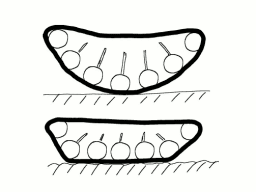
track867.gif

This would provide, when a wheel’s low-rolling and turning resistance weren’t required, a better response in terms of grip and load distribution.

Someone has now built a version of this (although they seem to be using extensible tracks and only two idlers, in a rather complicated mechanical system -but it certainly works).

#352: Virtual planning

When planning permission is sought for some new building, it can send small ripples of uncertainty around a neighbourhood. Amongst the local residents, there will usually be some knee-jerk noes and some don’t knows and some don’t cares.

In order to help people form a more informed opinion, today’s invention is simply to create a VR simulation of the proposed building, based on any CAD drawing that has already been prepared.

Viktors_Kozers_house864.jpg

This would need to be rendered in sufficient detail that issues like the before-and-after light levels could be investigated, together with questions regarding access, services, etc. I’d like to see an acoustic model incorporated which could help assess how noise levels might be affected for example, and for industrial buildings, how waste might be managed.

Only then could all parties really begin to understand the implications of a planned development -and have their concerns validated or negated.

The effort required to build such a model would be substantial (although more useful than a cardboard version) but it would provide a valuable extra hurdle in helping to prevent unwanted development or unfounded objections.

#351: Academics anonymous

Academics are restricted sometimes from making full use of their mental powers because the nature of their profession is that reputation counts for a lot. This can be easily misinterpreted to mean that making any unsubstantiable suggestion, or even slightly crazy proposition, is forbidden to them.

They therefore need a way to bounce early-stage ideas around with more than their trusted collegiate peer-group -but without exposing themselves to embarrassment.

Sue_RB_stjohns865.jpg

Today’s invention is a bulletin board for academics on which their postings appear anonymously. This allows them to contribute ideas without jeopardising their reputations or being intimidated by the “standing” of others. It would also mean, of course, that they would miss out on the credit for any of these ideas. (This could actually be good, in screening out those people for whom the business of intellectual creativity is just an ego trip).

At any time, anyone posting to a given thread could propose a group meeting to advance their thinking face-to-face (with a view to building some kind of research programme, perhaps). There could even be a mechanism by which those who were against a meeting might find themselves simply not invited to it.

#350: Monotrain

It’s been assumed, since trains were invented, that they would be giant, friction-driven monsters made of cast iron and brass.

Today’s invention revises that idea…by suggesting (again) that the existing tracks be used to carry micro-carriages.

Dave_Seeley_track850.jpg

These would flexibly transport small freight packages (maybe as small as a suitcase) and would run on only one track at a time. This would avoid all the nightmarish scheduling issues to do with having thousands of two-directional trains vying for the same track space.

Each small carriage would be made of lightweight materials and be individually driven by a small gas turbine -or even a modern steam engine with a low pressure jet exhaust (anything other than rail friction -maybe even mag-lev?).

What happens when vast numbers of these are heading for multiple collisions across the network? Well, each would also carry a lightweight sigmoid-shaped bridge rail. When a collision is predicted, the carriage would lower its bridge rail section to one side of the track and either park itself momentarily, in its own mini siding, or place it between the tracks in order to swap rails.

This approach would also allow all conventional rail traffic to continue on its merry way as normal.

#349: Screensaver

Cars should, in my view, not require any kind of fettling these days…even having to stop to fill them with fuel is a total pain (especially at £1.01 per litre). I take a similar view of having to fill the windscreen wash tank…ok, the water is free, but it’s still an unnecessary hassle.

Today’s invention is a water recycling system for car windscreens. Wipers would, instead of firing the water off sideways onto unsuspecting pedestrians, deflect it down the screen into a gutter at the base of both front and back screens. (I’d also site the spray nozzles at the top of the screen…I believe in making use of gravity, whenever possible). Dirty water would pass from here to a very crude filter tank (to remove the bugs, leaves and some exhaust particulates)…maybe even by a combination of centrifugation and settling.

john_macleod_wiper848.jpg

In a country where it rains every day, this would reduce the frequency of water tank filling to an acceptable once a year chore.

Use of a better filter would enable radiator top-ups to be taken care of automatically also.

#348: Skatecycle

It’s not exactly a majority interest, but riding a unicycle has always been on my list of personal challenges (ever since I learned how to juggle three small oranges for as long as 10 consecutive seconds. I already dropped out of astronaut training; after becoming travel sick on the bus).

Thrill-seeker that I am, I could always just buy a Segway, I suppose, but they have been outlawed as too dangerous for pavement use -this in a country where people routinely hammer down the streets in unlicensed electric wheelchairs.

gilles_van_leeuwen_skate849.jpg

Today’s invention is a training device which gradually enables unicycling. It consists of a skateboard cut in half and then bolted together in such a way that front and back halves can be slid over one other and then locked in position. A longitudinal slot allows the unicycle wheel to pass through the board. The board is then bracketed to the unicycle hub so that the main wheel and a maximum of two skateboard wheels are in contact with the ground at any one time.

This system thus acts as unicycle trainer wheels (combining two great ways to break your legs with the advantage that the wheelbase can be reduced as experience is gained). And not a gyroscope in sight.

#347: Protext

There are all sorts of rules which apply when you want to photocopy someone else’s document. Today’s invention is an attempt to limit the amount of such copying that can be done.

The vertical spacing between lines of text can, given current print technology, be subtly varied to act as a kind of barcode. These small variations could be undetectable by human observers and yet easily recorded by a photocopier.

daniel_wildman_book847.jpg

Such spacing might form a pattern unique to each book or even each page. When a (networked) photocopier is being used, it could easily identify the ISBN of the document in question (or even an id number of an individual copy) and refuse to make more duplicates than the legal limit.

#346: Integral hanger

Coathangers are well known to proliferate in wardrobes around the world and yet, when I need to hang up my suit, I can never find one (my other clothes are carefully hung on the floor).

Today’s invention attempts to solve the mystery of the missing coathangers (Their alternative usefulness as drain cleaners, dipsticks and advent crowns may also contribute to their local scarcity in my house, of course).

Ali_Farid_suit846.jpg

A triangular envelope would be incorporated into every jacket, across the back of the shoulders region. On removing the jacket, this could be inflated (using only a couple of breaths) to form a semi-rigid, flattish coathanger shape, capable of supporting the garment until next deflated for wearing.

This might actually provide better support than a knife-edged metal one. It could also embody a slot, within the triangle, through which a pair of trousers could be hung.

#345: Locaticons

Long numerical domain names defeat their purpose -you might as well try to remember ip addresses?…well, perhaps not. The boy’s own book of internet facts tells me that domain names like this are perfectly legitimate:

Steven_Griffin_pixels840.jpg

www
.00000000000000
.00000000000000
.00010000010000
.00101000101000
.00100111001000
.00100000001000
.00010000010000
.00001000100000
.00000101000000
.00000010000000
.00000000000000
.00000000000000
.00000000000000
.00000000000000.break-step.com

So anyone with a domain name can, using today’s invention, provide people with an image-based way to access their web content (using an in-page widget to record mouse movements in pixels and translate that into a url).

In practice, since people have trouble drawing accurately and there are 2^(14*14) binary variants on the above ‘image’, this scheme would probably need to be limited to a 5*5 grid. It’s surprising how many shapes can be represented recognisably within only 25 pixels.

A clever implementation would involve also mapping near-miss drawings onto the correct url.

#344: Double gazing

For those of us condemned to wear two pairs of spectacles (perhaps because bifocals induce motion sickness), life can become complex. The house-wide search for one’s other pair can be time consuming -just when you need to read that small print.

Today’s invention is a double pair of spectacles: two pairs joined together at the ‘legs’. When one pair of lenses is in use, the other pair is worn on the back of the head.

frances_magee_glasses839.jpg

When the user needs a change in refractive power, they are simply swapped over. There would probably need to be two springs connecting both pairs of legs, in order to enable this swapping in a comfortable way. This would also work, of course, for sunglasses as the secondary pair.