#2787: Puzzlinks

I’ll admit I’m a big fan of tracked vehicles, from snowbikes, to NASA launch crawlers to military tanks.

Today’s invention is a new form of track, especially for vehicles which are subject to damage or attack.

Imagine that the tracks are replaced by a series of parallel chains. These are driven by having a sprocket wheel for each chain -so that the drive wheel might have 5-10 co-axial sprockets.

This would avoid many problems associated with loading tracked vehicles onto trains (when they often need to be equipped with narrower track ‘shoes’)…we’d simply fit only the innermost two or three chains. In addition, when damaged, replacement of one or two chains would be much simpler than the very heavy (and space-wasting) sections of normal track.

Finally, each chain would be made from hardened links whose geometry mimics the metal puzzle shown. These can be joined without the need for any pins etc (making use of the small amount of slack, which tracks always have, to slide links together).

#2786: DramDice

Today’s invention is a way to make drinking more exciting.

A cup has a number of testtubes inside, each filled with some different liquid. The outside of the cup is tinted or opaque, so that users can’t see what is going on inside.

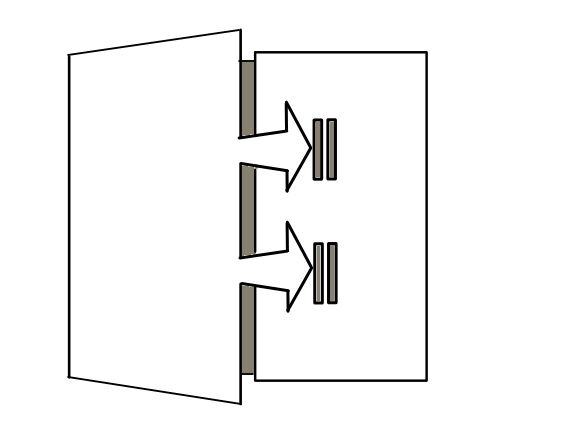
The green top forms a seal with the top of the testtubes. A drinker rotates the green top around a vertical axis, so that some testtubes are now in communication with a small number of bendy straws.

This allows the drinker to twist the top and make himself/herself an instant, random cocktail.
(See also #371: Rainbow drinks)

#2785: Kettlettes

Today’s invention is a new kettle design. Instead of one big bucket of water, it’s made up of several smaller, cup-sized kettles.

Only those kettles with water in will get heated, so that a user can easily choose how many cupfuls they need in advance and limit energy wastage.

This arrangement has the added advantage that you never need to be lifting a large volume of hot water…which is bad for muscle strains as well as the danger associated with scalds.

#2784: Gradation

Today’s invention is a climbing practice wall which has a programmable set of hand and footholds.

Each hold is a step which can slide inwards, to leave no protrusion, or outwards to make climbing easy.

The steps would be driven perhaps hydraulically from a central control board, making for a huge range of different routes and levels of difficulty on a single surface.

#2783: EjecTub

When fighter jet pilots eject, they usually have to do so by firing a detonation cord in the canopy that blows a hole in it -milliseconds before the ejector seat blasts them clear of the aircraft.

Today’s invention is a modification of this scheme. When flying over water, the canopy, which would be specially reinforced, is jettisoned in one piece and attached to the pilot’s seat by a long cable.

When the pilot splashes down, he or she now has a small, transparent life raft to get aboard.

It might even be possible to have this incorporate a small motor and propellor.

#2782: CAPillary

We are realising now that many sports, such as Rugby, Soccer and American Football, entail brain damage by repeated, low-level impacts.

Today’s invention takes the form of leather headgear, like a sparring helmet, which contains a number of packets of dyed fluid, distributed over the interior surface (something like paintballs).

These would be designed so as to burst when subject to either a fixed peak force or to leak after a known number of such impacts.

The fluid could be some bright (but not red) colour in order to be easily seen and not confused with actual bleeding.

This would allow players who had been hit to be withdrawn from play. If causing someone’s helmet to bleed resulted in a penalty against your team, it might also provide a way to encourage players not to target the heads of opponents.

#2781: SilentSurface

When a submarine surfaces through a couple of metres of ice, the cracking noise is significant and can certainly be heard by other people’s navies, using distant microphones.

It also risks tearing off external components such as hydroplanes and periscopes.

Today’s invention is for the submarine to extend a heat exchanger, connected using insulated pipes, to its engine towards the undersurface of the ice.

This allows for quiet and quite rapid melting, before the sub extents its periscope, checks the territory and comes to the surface through a pool of slush.

#2780: Parseal

At this time of year, parcel delivery companies use millions of metres of tape to seal up boxes.

Sometimes their choice of box size is suboptimal, but today’s invention is more concerned about the overuse of tape. This also makes more difficult the task of recycling the cardboard boxes themselves.

Instead of applying tape to every cm of box seam, boxes would be made with just a little extra material, to allow for the formation of a tang and slot(s) combination, every few centimetres.

These could be made so that a machine could engage the tangs with the slots firmly.

#2799: SwarfSentry

When you change the oil in your vehicle, it’s common to use a magnetic sump plug that collects ferrous particles.

Today’s invention extends that idea by embedding a sensitive magnetic flux sensor within the plug.

This Hall Effect device (of the same type as is used eg to sense wheel speed) detects changes in the amount of iron-based debris sitting on top of the plug and can thus be used to provide, say, a weekly insight into the wear that’s taken place within one’s engine (after track days, for example).

#2798: Chaserounds

Armoured vehicles can be made quite resistant to attack by eg shells, using clever, multi-layer armour.

Today’s invention seeks to lessen that resistance.

Imagine firing two shots in very quick succession. The penetration power would be much greater, since both impacts would occur at the same spot.

It’s hard, however, to have even an autoloading tank gun reload and fire quickly enough to achieve such a ‘double tap’ with heavy ammunition.

Instead then, fire shells which have a heat retaining rear end (or flare) to act as tracers.

Normal, relatively cheap, heat-seeking rockets carried by ground troops can be automatically triggered and fired within a second of the tank’s shot, so that the missiles follow and catch up with the shell.

This results in several items of ordnance arriving at the target almost simultaneously.