#1021: WhoaFlow

When a vehicle, say a landing aircraft, hits the brakes in an emergency, it’s usually in danger of becoming unstable, inverting and creating an even more dangerous collision.

Today’s invention is therefore an auxilliary, when-all-else-fails braking system.

jared_swafford_landing

When the brakes are applied very sharply, ultra sticky foam, of the type used experimentally as a non-lethal weapon, is automatically sprayed from a small tank beside each wheel.

This expands in milliseconds and causes the wheel to slow further in a controlled way, due to its extreme viscosity and adhesion. This foam grips the ground as well as the rotating components pretty nearly equally on both sides of the vehicle and it will also serve to snuff out any sparks which conventional brakes may be generating.
#1018: ScareShoal

Now that tidal energy looks like it may be commercially viable in certain locations, there is increasing pressure to ensure that devices such as subsea turbine blades create as little damage as possible to the local fish population (the danger is that thrashing blades might well form currents strong enough to drag fish towards them and chop up significant numbers).

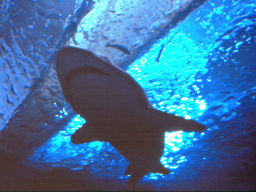
What is needed is an underwater scarecrow. Rather than just use a source of loud noises (whose vibration probably disturbs marine mammals too), today’s invention is a simulated predator.

gram_shark

This would take the form of a sinuously moving multi-section raft on the water surface, moored to the turbine in question. This could be caused to wave backwards and forwards by a small motor and would look from below like the silhouette of a large hunting fish, such as a shark.

#1016: sCARab

Today’s invention is a small, radio-controlled vehicle with rubber wheels containing powerful magnets.

These allow this small car to travel automatically over the outer metal surfaces of a normal car, checking for indentations or other damage. This could work well as a monitor for hired vehicles, being able to detect dents rapidly -damage that a driver might fail to even notice.

virag_vig_car

The sCARab could also act as a camera platform, snapping anyone in contact with the host vehicle and then hiding under the floorpan whilst calling the owner or police.

Such a device, equipped with a coloured paint pen and eraser, could create a constantly-changing pattern on the surface of the vehicle.

#1015: Lensfinder

For those new to inserting contact lenses, today’s invention is a way to ensure that the lens has been correctly fitted.

The contact lens case would contain a small bulb and battery. This would be held to the wearer’s temple briefly and the bulb lit.

barunpatro_arc

The outer edge of the contact lens on that side then forms a brightly-glowing arc in the visual periphery, indicating not just the presence but also the precise location of the lens. The arc also shows, by its profile, whether the lens is facing inwards or outwards. Future lenses, with circumferential asymmetry, might also indicate their rotational position on the cornea.

Do this in a dark room and an even more prominent after-image of the lens edge forms which can then be used to show up subsequent relative relocations of the lens on the cornea.

#1014: HideHues

Today’s invention is a way for military vehicles to camouflage themselves in real time.

Each tank or truck would carry some cans of suitable natural shades of paint on board. To avoid detection, each vehicle would use an onboard spray gun to subtly change its exterior shades -so as to minimise its visibility during different parts of the day, or season.

marija_jure

This repainting might even happen so fast as to mimic the motion of shadows on the surface, further breaking up the contours. If detected, rapid repainting with dazzle shades and shapes might help disguise the direction and size of the vehicle in question.

There could also be a small robotic scoop that could flick local earth over the finished coats, in order to improve their textural effectiveness. The paint itself would be rainproof but capable of being scrubbed off later using eg some diesel fuel.

#1013: NinjaNoise

Silencers on military firearms are really intended to modify the sound of firing, rather than mask it entirely -thus making it less obviously a sign of an attack in progress.

Today’s invention is a digital recorder and loudspeaker which is coordinated with the pulling of a trigger.

Lisa_Kong_soldier

When a shot is fired from a ‘silenced’ weapon, a very loud masking noise is played. This might be the slamming of a door or the barking of a dog, depending on the current context. For automatic firing, a naturally repetitive sound would be selected.

Recordings might even be made of ambient sounds in the current locale, in order to avoid drawing attention to the attack.

#1010: Placebo-oster

Drug companies are concerned about the increasing placebo effect (when the body gets better without medication, just because the patient is convinced that his treatment will be effective).

It seems to me that people having their own bodily defences triggered without having to pay for branded drugs is a good thing.

Andrew_Richards_patient

Today’s invention is intended to bolster the effect and also to create an atmosphere of effective self-help among sufferers of a particular condition.

Anyone who takes a certain drug and which is then successful in treating some serious disease, offers a picture of themselves smiling and recovered. These facial images are reproduced on the packaging of appropriate medicines, together with an empathetic message (and access to an online support community of these volunteers).

#1008: CureRoll

I’m always accidentally dropping tablets on the floor and watching them scoot away beyond reach (only later to attract the attention of passing pets or children).

Today’s invention is a pill shape consisting of back-to-back cones. When dropped, this will roll in a circular arc with limited radius and thus its final location will be predictable…making it safely retrievable without calling a plumber.

Laura_cone

This would be no less easily swallowable than other geometries but it might also need a coating of gel (such as the cod liver oil pellets I take) in order to limit the roulette wheel bounce effect.

#1004: TwinTool

It’s now well established that networks work optimally, in the sense of transmitting information, when connected as a small-world.

Today’s invention is a tool which works on data from social networking systems such as LinkedIn.

Vivek_Chugh_introduction

This would scan the profiles of one’s connections and match the found keywords to those found for other personal subnetworks. The tool would then introduce one member from each of two matched groups, in order to make the sparse but longrange connections between ‘neighbourhoods’ which are characteristic of efficient networks.

This would actually result in more of the kinds of links to influential people which one hopes to make on signing up on such Web 2.0 websites.

#1003: Abseiluge

Several of my ancestors are known to have been keen on throwing themselves, attached to parachutes, from aircraft. I share their interest and today’s invention reflects this.

Members of the armed forces routinely descend on ropes, by abseiling techniques, from cliffs and helicopters around 60m high.

Sven_Golz_cables

Now that we are seriously contemplating building space elevators using carbon nanowires, I suggest employing this ultra-strong, inelastic material as an alternative to parachutes. People in aircraft could abseil several thousand feet on a wire of this type and land in a more coordinated group. Each wire would be strong enough to support many laden troops at once.

The speed of their descent would allow a safer deployment (due to being harder to shoot at) and the final braking of many men could be via electronically coordinated friction brakes so that they could be dropped from only a few feet above the ground.

Injuries from their horizontal speed component could be guarded against by equipping them each with a heavily padded sledge on which they could then skid to a halt.