#1687: SlowedShower

It turns out that airliner brakes can reach 1400 deg C, when used hard during an aborted takeoff.

A delay of five minutes is then expected once the plane has actually stopped -before any fire engines can deal with the melting undercarriage and the threat of a major fire.

Today’s invention is to adopt the simple approach of running some pipework from the aircraft’s waste water tank(s) to above the wheel wells.

Whilst waiting for fire appliances to appear, the crew can open a valve and sluice the entire area in water, just before the passengers depart down the slides.

There would be a fair bit of steam and not a little smell, but at least there would be a reduced chance of disembarking people into a kerosene fire on the runway.

#1686: SpaceSpear

There are several different approaches to space tourism.

Today’s invention is an alternative.

A needle-shaped, helium-filled airship, made of eg carbon nanotubes, is orientated with its long axis vertical. This would need to be ~400m in height and with a cross-section just big enough for the occupant to stand up in with his parachute and breathing apparatus.

The atmospheric pressure differential from top to bottom would be enough to drive this low-drag needle upwards when released, exceeding the 36km height limit for balloons.

Lessening drag would allow the ship to reach perhaps 50km, before falling earthwards. A parachute would automatically be deployed, allowing the airship to be reused.

#1685: Mosquitornado

Today’s invention is a tool for disrupting the lifecycle of the mosquito responsible for transmitting malaria.

A helicopter has a main rotor the blades of which can be reoriented so that, instead of driving air downwards through them, it pulls air upwards.

The machine is flown to a shallow puddle in which mosquitoes are known to be breeding (and which is probably too stagnant for safe drinking). It settles on the bottom of the puddle and runs its blades in reverse.

This sucks up all the water, mosquito larvae and all, dispersing the lot into a rising column of air within a few minutes -and thus greatly reducing the numbers of insects which reach maturity.

#1684: DisenGauge

From across the globe, we hear about train derailments almost on a daily basis.

Today’s invention attempts to lessen the severity of such incidents.

Each carriage would have some wheels at each end fitted with sensors which could detect when a wheel had lost contact with the track (a magnetic field sensor mounted in a radial recess on the rim would be sufficient).

When that happened, the coupling to carriages ahead and behind the derailing car would instantly break (perhaps even pushing away as they did so). All brakes would be automatically applied at the same time.

This would result in only one carriage leaving the track -without dragging several others with it.

#1683: Applookation

Those of a nervous disposition should look away now. It seems there is a subset of humanity, mostly females, who enjoy squeezing greasy spots.

Today’s invention is a touchscreen-based application designed to cater to such a minority interest.

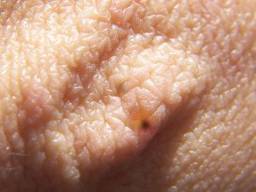
A photograph would appear on-screen of one of a large collection of real spots and blackheads.

Squeezing the screen radially inwards towards the centre of each spot, would result in the display of an image of the spot’s contents expertly cleaned out (a suitably-realistic plopping sound effect could also be provided).

#1681: Brrummbrella

Today’s invention is a replacement for those old solid wheels and pneumatic tyres.

Imagine the frame of an umbrella used as the spokes of a car’s wheels.

A segmented (blue) wheel rim supports solid (grey) tyres.

The wheel nut can be tightened or loosened remotely, allowing the umbrella skeleton to press radially outwards or relax slightly inwards very rapidly… removing the need for a conventional suspension system.

When a quick change of tyre is required, the nut is removed and the skeleton collapsed to allow a new tyre to be fitted easily onto the wheel segments.

#1675: Twainsaw

Today’s invention is a chainsaw in which the chain is looped so as to allow two stretches both to move in parallel towards the body of the machine.

This creates a V-shaped gap into which eg tree limbs can be fitted and cut more easily -because, being wedged in place, the pressure required to be sustained by the user is much less.

This allows a variety of sizes to be cut, with less effort, and also limits the size of cut, so that people aren’t tempted to take on redwoods (thus a) damaging valuable mature trees and b) burning out their motors).

#1672: BladderBarrier

Inspired by blob jumping, today’s invention is a non-pyrotechnic airbag for use in cars.

It consists of a reinforced air bladder arranged, one per side of the vehicle, as shown on the left.

A side impact (in the right image) absorbs some of the energy from the colliding vehicle and inflates the central barrier, protecting occupants from injuring each other.

Built strongly enough, this system would resist several impacts and require no special timing devices to activate.

#1670: EnginEqualisers

Inspired by the Aero-engineering designs of Burt Rutan, I began to wonder what happens to the handling characteristics when an engine fails aboard a multi-engine jet.

Today’s invention is to equip such aircraft with under-wing rails (orange) (like those used to support munitions on military planes).

In the event of an engine failure, the remaining engines can be repositioned quickly by sliding laterally along under the wings.

This allows their centre of thrust to be kept in line with the fuselage and the flight dynamics changed as little as possible.

#1666: ShakeSeat

There is a danger to drivers in becoming so cosseted by their vehicles’ support systems that they make mistakes.

Today’s invention is a driver’s seat which operates like those in cinemas which react to film content and give the occupant a small shake.

Everyone who had ever skidded on ice, even a little, knows that the effect is to get one’s attention very tightly focused on the job of driving.

The seat in question would therefore react to a period of no driver movement (sensed by measuring weight distribution on the seat panels) with a very small-amplitude simulated skid movement.

This would get a dozy driver to sit up and pay attention.