#465: Bucketflow

There are several new digital drawing and painting tools I’d really like to see made available, based on the behaviour of real paint.

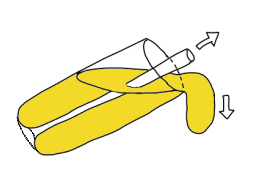
The first of these is pretty simple. Today’s invention is a ‘bucketfill’ tool whose paint progresses radially outward from the point clicked on the screen at a pace which allows the user still to keep track of the paint’s leading edge -and stop its progress if necessary.

Craig_Jewell_paint1102.jpg

Not only would this be more like dropping a dollop of real paint (you could incorporate various realistic sound effects and transient translucency as well -if you had an embarrassing surplus of computing power). I’d also include some surface tension, viscosity and wave physics so that, as the paint front approached any small inadvertent gaps in the surrounding ‘dam,’ it wouldn’t necessarily spill out and instantly colourise the entire screen but instead highlight these glitches so that they could be plugged.

Aside from these aesthetics, the time course of filling a particular shape (from a variety of known starting points) could be used by the program to identify the shape being painted.

#464: Pace-sweater

It’s often very annoying that I can be doing my best impression of exercise when the music on my MP3 device starts playing at completely the wrong beat.

Today’s invention is therefore a mechanism on a portable music player which will allow selection of a particular beat and play only tunes with that rhythm (or one close to it).

Iwan_Beijes_jogger1156.jpg

This could also be interfaced to a rowing machine or treadmill so as to select tunes that corresponded to the current stroke rate or pace. Ideally this would be set to choose a beat which was slightly faster than the current exercise frequency in order to keep up one’s work rate.

I’m not sure exactly how sensitive to rhythm variations we are, but it might also be possible to play any given piece of music at a slightly elevated rate, in order to better match the target level of effort.

#463: Meshaping

Finite element methods are commonly used in engineering design. You create a CAD drawing of your component, automatically divide it up into a mesh of a million tetrahedra, apply some realistic loading boundary conditions and material properties and finally compute a detailed stress map within the design. If you are nearing yield stress anywhere, it’s time to think again either about geometry or material spec.

Today’s invention is simply then to use the 3-D mesh of tetrahedra as a specification from which to actually build your design. I’d like to see this happen using a rapid prototyping system. Each tetra could be ‘printed’ as a net of four triangles, joined along three edges. As each is produced, it would be automatically folded and the six free edges bonded into the 3-D ‘pyramid’. The system would spit these physical elements out in the correct sequence (and orientation) for them to be bonded together to create the overall design.

mark_robbins_ducati929.jpg

This would already have been shown to withstand the required in-service stresses. It would represent a huge material saving, compared to using bulk material, and although the final shape would still have a rougher ‘crystalline’ outer surface, this would be a structure with low form drag and a genuine wow factor in the marketplace (think Ducati frame taken to extremes).

#462: Soundsearch

Search has become fascinating for two reasons: the recent availability of an abundance of interesting stuff (if only you knew where it was) and the possibility of automating its retrieval.

One of the biggest problems, it seems to me, is that we currently aren’t really making use of all the tools available to us. It’s still hard work to find things visually or kinaesthetically in a reliable way, but sound offers a more tractable approach.

Valentina_Degiorgis_words1151.jpg

Today’s invention is to store a phonetic representation of every word in a document or webpage. This would enable a search by sound to occur in which we could say “find me things that sound like fandango” or even, in wildcard mode “…things that sound like blahblah_blah_blah_ford.” This is pretty much how I try to retrieve people’s names from my own memory, and it seems particularly good for things whose names don’t mean anything but whose phonemes may be identifiable as words …eg brands like coca-cola or phentermine or whatever.

This makes me wonder if, by populating one’s website with spam brandnames, you would be less bothered by the makers of smarter, targeted spam (the kind of message about which you think ‘is that spam or is it a genuine message?’ ). These people know it’s a bad idea to pepper spam blockers with data that helps them extract a characteristic pattern and thus defend themselves.