#1277: Airshield

Modern snipers can kill people who are up to two miles away. To do this, they use some very advanced calculations to adjust their aim according to the anticipated effects of wind, humidity, altitude etc.

These influences are so great that snipers may have to aim at a point 2m to one side of their actual target.

Today’s invention is a defence mechanism against such attacks. The blue force roll out a camouflaged line of sensors B, using eg a radio controlled robot vehicle. These lie on two parallel tracks, so that the passage overhead of the shock wave of a high-velocity bullet can be detected and its direction estimated.

This information is sent wirelessly to a line of air blowers A (faster than the bullet can travel). A few of these can issue an upwards jet of air in a random direction, from underneath the passing round.

This deflection can be more than enough to cause the shot to miss with very high probability; alerting the blue force to red’s position and undermining the sniper’s confidence.

#1263: BarrAsh

Following the recent furore about volcanic ash in the atmosphere, the UK’s Civil Aviation Authority has decided that 2mg/ m^3 is the airborne ash density below which it’s ok to fly.

Military aviators are a lot less cautious about air quality. They also have a range of countermeasures they can employ when being pursued by their opposition. Having seen the damage which ash can cause in a jet engine, today’s invention is a countermeasure based on this.

When followed by a jet aircraft, the target plane would start to inject some of its own ceramic engine outlet components into its exhaust stream, so that they burned (like an ablation shield on a space capsule).

This would periodically cause visible, dense puffs of silica ash (locally >>2mg/ m^3) to be ejected and cause any pursuing aircraft to avoid the clouds. The clouds themselves would remain airborne, a little like barrage balloons, until normal turbulence dispersed them.

#1262: SignalSip

Energy drinks apparently start to help one’s muscles work as soon as they make contact with the tongue.

That weird finding, via which the receptors of the tongue somehow inform one’s flagging muscles that ‘help is coming’, is the basis of today’s invention.

For those who find their lives threatened by exhaustion (such as soldiers, explorers or firefighters) it takes the form of a steel water bottle with a lockable lid (and an inaccessible, recessed valve).

The lid contains a timer device which opens a spout for say one second every half-hour (as determined for the operation concerned). This allows someone to take very short slurps of the sugar water inside, enabling them to keep going whilst preventing them from simply draining the contents.

It might even be possible for a version of the bottle to open the spout in response to radio signals from base, in order to maximise the chance that the bottle carrier can get him/herself back home in one piece.

#1253: CarrierBarrier

For all the clever electronic systems on board, naval ships are still vulnerable to attack by torpedo and by small, fast boats.

Aircraft carriers in particular have a turning circle the size of the equator. Today’s invention is intended to help such large ships resist attacks.

It consists of a mobile palette which can be rolled into position to secure a jet plane rigidly to the deck of a carrier. In the event of an attack, palettes would rapidly swarm under parked planes, turn them to align axially with the direction of approaching threat and fire up their engines.

Given the massive power output of a deckload of jets, this would cause the vessel to roll severely. Firing of the engines several times in synchrony with the roll rate would produce waves of huge amplitude -big enough to sink or deflect many forms of near-surface attack.

#1235: FlightDeck

I read recently about how fighter planes are frequently scrambled in response to the use of certain words in transmissions from planes. Words like “bomb” and “hijack”.

The fighters are supposed to deflect an aerial attack by first making rude gestures at some incoming plane, followed after a decent interval, by shooting it down (presumably so that it crashes somewhere less publicity-worthy -ie anywhere that isn’t London).

Today’s invention attempts to avert this disaster. In the event that an airliner was suspected of being used in an attack, a special aircraft would be launched from the nearest airport.

This would be effectively a flying bombproof runway or deck. The deck plane would approach from underneath and behind (invisible from inside the captive aircraft).

It would activate the engine cutoff valves, causing the plane to settle onto the deck and be held in place by clamps on the wings. The captive plane could be boarded by special forces and the combined craft landed somewhere discreet very rapidly.

#1226: Jetrims

I was inspired by this guy‘s tip-jet helicopter to apply the principle to terrestrial vehicles.

Today’s invention is a new form of motor in which each wheel has a number of jets fitted on the periphery of its rim. These jets are designed to maintain a horizontal, rearwards pointing orientation as the wheel turns.

Each jet is supplied with a gas at a pressure which is regulated to increase as its height above the road increases.

Since each wheel turns instantaneously about the road contact point (assuming good grip) this distribution of force provides a near-maximal torque characteristic.

This would require a tank of highly compressed gas (eg air) to be carried, but is much less ‘lossy’ than supplying the gas to a conventional car engine to drive pistons etc. Drive to each wheel could be optimised by the use of electronic control valves in each wheel.

#1225: DeLayer

Minefields aren’t ever really ethical, even if they are defending your family from some foreign army. Today’s invention is a new way to lay mines which is somewhat less horrendous than normal.

A robot device is programmed to traverse a stretch of territory, pressing into the ground small, bullet-like mines (designed to hold up an attack, by inflicting minimal wounds when triggered by an incautious boot).

The robot keeps a very careful record of where these devices are placed, laying them randomly within a designated secret region. It then parks itself prominently somewhere where there is no mine.

The approaching army sees the bot, understands there is a minefield ahead and makes a cellphone call to the number displayed on its casing.

This causes the robot to start retracing its steps, neutralising the mines by firing them vertically upwards. This it does however exceptionally slowly.

When the process is complete, the bot destroys itself. The result is that a cheap minefield has delayed an oncoming army, been completely cleared and left no technology behind to be ‘repurposed’.

#1219: Segmentyre

Today’s invention is a new form of tyre which can be changed without removing any wheels and jacking up a couple of tonnes of steel.

It is in the form of a number of rubber compartments, each with a metal foot bonded on. These feet are slotted axially into a hub, as show, by slightly deflating the adjacent segments using the valve which each incorporates.

Repressurisation allows the whole tyre to be used rapidly…there is no longer any need to carry a giant spare tyre…a couple of extra segments should suffice.

#1218: CautionMan

Parents these days are often unhappy about equipping their progeny with ‘war toys.’

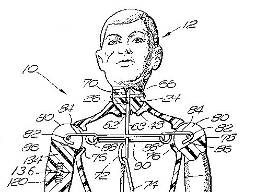
I used to love playing with Action Man (or GI Joe as the original patent specified). Today’s invention is a new version of this old favourite with a slightly more moral approach.

This takes the form of a figure fitted with a wii-like accelerometer and a microphone. If the figure is subject to too much noise for too long, some of his joints are automatically loosened (using a battery-powered, geared internal motor which withdraws the screws holding limbs in place).

After a ‘recovery period’, the joint friction is restored by reversal of the motor.

Excessive noise and impacts would result in limbs becoming fully and irrevocably detached, thus illustrating that even legendary warriors are not invulnerable.

A range of scale equipment, specifically aimed at rehabilitating such wounded servicemen, would also be on sale.