#1231: Incendascent

Glider pilots won’t hear tell of carrying any kind of motor aboard their craft which might be used to save them in an emergency (a parachute is just about acceptable among engineless aviators).

I talked yesterday to a gliding enthusiast and she mentioned that when trying to find a landing site, she will routinely seek out any sources of warmth on the ground, as even the sun-warmed wall of a hut can provide a lifesaving updraught.

Today’s invention is a magazine of high intensity flares which are dropped on the ground when a glider pilot runs out of lift sources and landing sites.

The pilot flies in a circle and and drops the flares at intervals. These have a brightly coloured casing and when returned to the owner, provide the retriever with a payment. They have an insulated base so that heat can escape only upwards.

On a second circuit, this time over the flares, the glider picks up enough altitude to hedgehop home.

#1226: Jetrims

I was inspired by this guy‘s tip-jet helicopter to apply the principle to terrestrial vehicles.

Today’s invention is a new form of motor in which each wheel has a number of jets fitted on the periphery of its rim. These jets are designed to maintain a horizontal, rearwards pointing orientation as the wheel turns.

Each jet is supplied with a gas at a pressure which is regulated to increase as its height above the road increases.

Since each wheel turns instantaneously about the road contact point (assuming good grip) this distribution of force provides a near-maximal torque characteristic.

This would require a tank of highly compressed gas (eg air) to be carried, but is much less ‘lossy’ than supplying the gas to a conventional car engine to drive pistons etc. Drive to each wheel could be optimised by the use of electronic control valves in each wheel.

#1225: DeLayer

Minefields aren’t ever really ethical, even if they are defending your family from some foreign army. Today’s invention is a new way to lay mines which is somewhat less horrendous than normal.

A robot device is programmed to traverse a stretch of territory, pressing into the ground small, bullet-like mines (designed to hold up an attack, by inflicting minimal wounds when triggered by an incautious boot).

The robot keeps a very careful record of where these devices are placed, laying them randomly within a designated secret region. It then parks itself prominently somewhere where there is no mine.

The approaching army sees the bot, understands there is a minefield ahead and makes a cellphone call to the number displayed on its casing.

This causes the robot to start retracing its steps, neutralising the mines by firing them vertically upwards. This it does however exceptionally slowly.

When the process is complete, the bot destroys itself. The result is that a cheap minefield has delayed an oncoming army, been completely cleared and left no technology behind to be ‘repurposed’.

#1224: Hushouse

If I’m staying in a hotel, it’s often hard to work out which room is making that infernal racket late at night.

Today’s invention is a way to help. Each room would have a touch sensitive cube on a fixed stalk. If the occupants were bothered by noise, they could simply press the sides to show from which direction it seemed to be coming. This would send signals to a central computer allowing the offending room to be identified as shown.

It might even be possible (joy) for this to result in the automatic volume reduction or disconnection of any TVs or stereos plugged in within that room (perhaps in proportion to the number of other guests irritated).

#1219: Segmentyre

Today’s invention is a new form of tyre which can be changed without removing any wheels and jacking up a couple of tonnes of steel.

It is in the form of a number of rubber compartments, each with a metal foot bonded on. These feet are slotted axially into a hub, as show, by slightly deflating the adjacent segments using the valve which each incorporates.

Repressurisation allows the whole tyre to be used rapidly…there is no longer any need to carry a giant spare tyre…a couple of extra segments should suffice.

#1216: FeatureFocus

The web is full of sites which provide a shopping function like this, in which a chosen region of a product image can be shown in close-up.

So, the bits people look at can be used as a way to discern what they want to buy. If they pay attention to the fur collar, the zip, the pricetag, that tells you something about their interests. Whether they buy or not, you get a wealth of information about their priorities.

Today’s invention is a tool which simply monitors the close-up window’s placement sequence and spots patterns which enable enhanced product development decisions. If a number of people leave the page without buying, having just seen the details of the leather grain, you know something needs fixing.

The tool would also do some tricks like issuing messages such as ‘was it the [leather]? Maybe look at these items instead…’ It might even be possible to offer realtime, personalised discounts: ‘Maybe it’s not exactly what you were looking for -so how about 5% off?’

#1215: DamnedSpot

Today’s invention is another tool to help improve the handwashing of hospital medics (a New York Times article recently claimed that washing only happens about 1/3 as frequently as training requires).

All medical staff in contact with patients would wear a brightly coloured bracelet. This would contain an aerosol full of harmless, water soluble paint.

The bracelet would also contain a timer which would ensure that a small spot of bright paint was delivered onto the back of a medic’s hand, say every ten minutes throughout the day.

Appearance of the paint would remind wearers to wash their hands at once. Patients could raise an objection if either the bracelet wasn’t worn or there was a spot of paint on the hand of their examiner.

#1198: Smartshield

Armored vehicles, such as the bulletproof vehicles used by heads of state are often equipped with reactive armour. When a missile makes an impact, this detonates a surface charge on the vehicle, potentially nullifying the attack.

Today’s invention takes this a step further. When two or more impacts have occurred on such a target, an on-board computer records these and calculates where the most likely subsequent hit will occur (linear extrapolation would be a good first guess).

At this location, reactive armour can become proactive. This might involve firing a shield mechanism so that impact occurs between shield and missile at a greater stand-off distance from the vehicle body (or, it might be possible to populate the outer vehicle surface with protective plates capable of being moved rapidly across it, by a magnetic field pulse, to provide local reinforcement).

#1190: PlayScale

Given the rise in obesity the range of bodyweights amongst youngsters is widening.

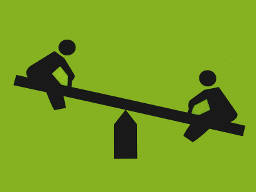
In the playground, this may mean that any two children are unable to enjoy a see-saw together.

Today’s invention is therefore a see-saw mechanism which measures the weights of two children who sit on it and subtly shortens the side on which the heavier child is seated -so as to bring the device into balance (probably by sliding the seats along the seesaw rail).

This means that both fat and very skinny children get a chance to play (and exercise) together.

#1183: LawAndBorder

As you drive from state to state in the US, or even between certain countries in the EU, important laws can change suddenly without your being aware of it.

Today’s invention is a modification to one’s in-car GPS system which detects the crossing of any such border and flags up the most important changes in the law that just occurred.

Those laws involving transport would be emphasised and the system might also take into account the probability of occurrence as well as the severity of the penalties for transgression.