#1225: DeLayer

Minefields aren’t ever really ethical, even if they are defending your family from some foreign army. Today’s invention is a new way to lay mines which is somewhat less horrendous than normal.

A robot device is programmed to traverse a stretch of territory, pressing into the ground small, bullet-like mines (designed to hold up an attack, by inflicting minimal wounds when triggered by an incautious boot).

The robot keeps a very careful record of where these devices are placed, laying them randomly within a designated secret region. It then parks itself prominently somewhere where there is no mine.

The approaching army sees the bot, understands there is a minefield ahead and makes a cellphone call to the number displayed on its casing.

This causes the robot to start retracing its steps, neutralising the mines by firing them vertically upwards. This it does however exceptionally slowly.

When the process is complete, the bot destroys itself. The result is that a cheap minefield has delayed an oncoming army, been completely cleared and left no technology behind to be ‘repurposed’.

#1224: Hushouse

If I’m staying in a hotel, it’s often hard to work out which room is making that infernal racket late at night.

Today’s invention is a way to help. Each room would have a touch sensitive cube on a fixed stalk. If the occupants were bothered by noise, they could simply press the sides to show from which direction it seemed to be coming. This would send signals to a central computer allowing the offending room to be identified as shown.

It might even be possible (joy) for this to result in the automatic volume reduction or disconnection of any TVs or stereos plugged in within that room (perhaps in proportion to the number of other guests irritated).

#1222: Bottleblunter

I sometimes see young men who have been facially disfigured in a brawl with someone using a broken bottle or glass. This is a problem significant enough for pint glasses themselves to have been redesigned.

Today’s invention is a simple device to be used in pubs. Before a bottle is de-capped and handed to a customer, the bartender inserts it into a circular aperture and turns it through 360 degrees.

This aperture contains a small diamond glass cutter which scores around the neck of any bottle, 30mm from the cap.

It’s exceptionally difficult to break any bottle cleanly, so the effect that this scoring will have is that the bottle, held by the neck, will snap, when it is struck on a table top to make a weapon, in such a way that the potential attacker is left holding a very short, painfully jagged piece of glass.

Not only is this hard to hold and therefore pretty useless as a weapon, it also makes them look rather ridiculous.

#1220: Wheelegs

Today’s invention reinvents the wheel…again. It started by thinking about how animals like the cheetah move at speed by flinging back legs forward over front legs which are gripping the ground -even very rough ground.

A vehicle (blue) is fitted with a large number of axles. Each has a cylindrical sleeve on both ends which rotate with the axle. In the sleeve, a ‘leg’ is located, so that it can be driven axially within the sleeve (perhaps by use of a screw thread driven by a motor on each axle).

The vehicle would have many wheels operating in sequence, as shown -allowing the overlapping legs to reach forward, grip the ground, push backwards and then be withdrawn axially (or rotated) for a new cycle.

This would allow rapid cross-country movement, potentially with no vertical motion of the vehicle body.

#1219: Segmentyre

Today’s invention is a new form of tyre which can be changed without removing any wheels and jacking up a couple of tonnes of steel.

It is in the form of a number of rubber compartments, each with a metal foot bonded on. These feet are slotted axially into a hub, as show, by slightly deflating the adjacent segments using the valve which each incorporates.

Repressurisation allows the whole tyre to be used rapidly…there is no longer any need to carry a giant spare tyre…a couple of extra segments should suffice.

#1218: CautionMan

Parents these days are often unhappy about equipping their progeny with ‘war toys.’

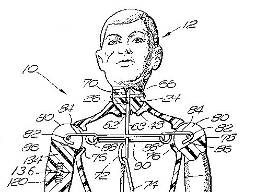
I used to love playing with Action Man (or GI Joe as the original patent specified). Today’s invention is a new version of this old favourite with a slightly more moral approach.

This takes the form of a figure fitted with a wii-like accelerometer and a microphone. If the figure is subject to too much noise for too long, some of his joints are automatically loosened (using a battery-powered, geared internal motor which withdraws the screws holding limbs in place).

After a ‘recovery period’, the joint friction is restored by reversal of the motor.

Excessive noise and impacts would result in limbs becoming fully and irrevocably detached, thus illustrating that even legendary warriors are not invulnerable.

A range of scale equipment, specifically aimed at rehabilitating such wounded servicemen, would also be on sale.

#1214: FallFan

I’m contemplating getting aloft using a paramotor. If the main ‘glider’ (sail-type parachute) fails, one is ordinarily equipped with a reserve chute, but this is of little use at operational flying levels of ~200m.

Today’s invention is therefore a paramotor fan which can tilt from a horizontal axis to a vertical one, when the pilot realises that a crash landing is imminent. It would automatically jettison the glider canopy once the decision to use the motor in this way was made.

Although the fan could never support a pilot’s weight on its own, it could, in an emergency, greatly reduce the rate of descent, especially if driven at an almost self-destructive speed in this last-ditch mode.

#1213: BlowLow

When I see windfarms, several questions occur to me -beyond ‘Do we really think these are a viable energy source?’ Why, for example, is all the gearing and generating equipment located 10m in the air?

Today’s invention is a new form of wind turbine. Two sets of turbine blades rotate about a horizontal axis on top of a column. The outer ends of each set of blades are supported by a bevel-geared ring which bears on a vertical-axis bevel gear wheel near the ground. The blades-and-wheel assembly is free to rotate about this vertical axis in response to changes in wind direction, as usual.

As the wind blows, the gearwheel rotates a generator located conveniently near ground level and protected within the support column (which can be a comparatively low-strength structure). No more swinging the whole affair around in the sky.

#1210: Miragebarge

Today’s invention is a way for ships to avoid being seen at sea.

The ship would carry a large mirror held aloft on stalks.

It would also have a large pontoon supporting metal plates heated directly by the ship’s engines.

This arrangement would generate a synthetic mirage -one in which a distant observer would see a patch of sea, rather than the ship itself.

#1207: Viscode

Today’s invention is a private key encryption device which relies on fluid dynamics.

Highly viscous flow at low velocity is, near-as-dammit, reversible.

Today’s invention is to use an apparatus such as that in the film linked to above. A message (or an image) would be printed into the body of a gel-like material using eg laser-based rapid prototyping techniques.

This would then be subject to a pattern of low speed rotational shear flow, using a rotary system as shown, to obscure the content. This rotation would however be undertaken by an inner cylinder which could move both circumferentially and axially (as controlled by the user’s choice from a large number of screw cam ‘keys’). The gel could then be transported physically anywhere without the message being decipherable.

It might even be possible to send only images of the gel electronically (ie its local contrast distribution). On receipt of the message, it could be decoded by reversing the action of the original key.