#1985: CarriAir

One trouble with air is that it’s mostly nitrogen -which is not much use in combustion engines.

Today’s invention is a mobile cart or trolley which helps eg carrier-based aircraft take off by supplying extra oxygen.

It achieves this by containing a cylinder of compressed oxygen which it sprays into the jet engine intakes as both plane and trolley move in unison along the deck.

This provides a controllable additional burst of engine power -enabling shorter and/or more heavily-loaded takeoffs to occur (without breaking the existing steam catapult mechanisms).

#1983: SwellStable

For those of us who aren’t great sailors, today’s invention allows complete freedom from the effects of water movement beneath a ship.

It is essentially one of those fairground rides in which a container is supported on a set of (very long travel) hydraulic rams.

This would be mounted on the deck, so that a set of sensors would gather data about the vessel’s accelerations and drive the rams so that the box would travel as if on horizontal rails.

This system might also speed its performance by learning to predict the seas’ movement for the next few milliseconds.

A small number of passengers could pay a hefty premium to travel across the world’s oceans without suffering seasickness.

#1980: StreetShare

Today’s invention is street advertising hoardings which get themselves pasted online too.

Adverts on street-level billboards would have a dotted line figure (or figures) included.

People would have their photo taken in this amusing or incongrous setting, so that the image would be posted on say their facebook profile and shared.

The reposting of the image would allow many more people to see the original poster. This process could also result in prizes for those appearing in the most popular images of a given advertisement.

Another version might allow the facial feature distribution of a person imaged to be used as a code to select some additional message or bonus content to be injected into the final, online image.

#1979: Autonomobile

It appears that the world (or at least some US states) is about to allow driverless cars onto its streets.

Today’s invention is to take that to another level by introducing riderless motorcycles.

These could be used in a number of roles. First, they might be employed to deliver packages quickly between offices, using much less fuel than a car and without creating traffic jams (bikes would probably be electric, gyro-stabilised and designed to prevent humans climbing aboard).

Second, they could be injected into motorway traffic streams and, by coordinating their speed adjustments via radio, help smooth out the waves of braking and acceleration which lead to tailbacks and collisions between human-driven vehicles.

#1977: Benchtest

Justice must be both done and seen to be done.

Apparently, however, when judges are hungry, they are much less likely to eg grant parole.

Today’s invention is therefore a way to lessen the large fluctuations which have been measured in judicial opinion.

Before passing judgement, lawyers could require a judge to self-administer an electronic test.

This would take the form of a games console which would run some perception/reaction tests and take a drop of blood to monitor blood glucose level (it might also be used to detect other substances).

If this, or the concentration test scores, had fallen below average for the individual, lawyers could ask that a court case be deferred until the judge had had lunch and a rest.

#1976: SuitSeat

There have been lots of articles online of late about how Formula 1 drivers have special seats, designed, as everything in their lives, to satisfy their personal requirements.

Today’s invention is instead to equip open-cockpit race drivers each with an inflatable suit, which would completely take the place of a seat.

The suit would contain bladders filled with air, providing exactly the right level of support in all the right places.

This would reduce the weight in the car, provide extra lateral bracing during cornering as well as neck protection during braking.

The suit bladders would be deflated to enter the car and on sitting in the bare frame, they would be connected to a source of compressed carbon dioxide.

In the event of a crash, the air bags would help provide protection and certain bladders on the sides of the suit would automatically deflate -helping the occupant/wearer to get out rapidly (It might even be possible then to use impact energy to overinflate bags under the driver’s body, to help lift him out of the cockpit).

The gas would also act as an additional fire retardent.

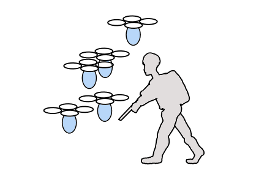
#1974: SwarmShield

Robot quadricopters can now be act cooperatively and fly in an aerobatic swarm (See eg this and this).

These developments open up the real possibility of today’s invention: a mobile, bullet-resistant shield for infantrymen.

Each member of a platoon would be assigned say five of these machines.

As he or she exited a helicopter or armored personnel carrier, their copters would take off from their locations on its surface and fly in front of the troops.

Each machine would carry a small shield, made of bullet resistant perspex. This would avoid obscuring the way ahead.

In the event of an attack, the copters would instantly react and cooperate so as to form the best possible defensive shield in front of the lead soldiers.

If any units were damaged, the others would compensate, giving time for a defensive response.

#1973: ShiftShaft

Audi once developed a safety system which moved the engine in a car during a crash so as to avoid impact with the occupants.

Today’s invention moves the engine and gearbox in a vehicle, but for different reasons.

As shown, the (blue) engine/gearbox unit is threaded onto a splined drive shaft and is free to slide along this axially within an enlarged transmission tunnel between the seats.

Its position would be changed using a worm/wheel combination and so the vehicle could automatically adjust its centre of mass from moment to moment according to the current dynamics (as measured by several accelerometers).

Cars would therefore be capable of sharper direction change, under better control than ever before.

#1970: Silencereflex

When a professional photographer takes a picture, from a position physically close to his subject, the chances are that his SLR mirror mechanism will make an intrusive noise.

This, I’m told by people who do this for a living, is actually valuable feedback, which they would not want to do without -even though it can be an irritation for someone who is concentrating on a task.

Today’s invention is therefore a digital SLR with a carefully silenced mirror (this could be done with a combination of softer gears and a padded seal onto which the mirror would be brought quietly to rest).

In order to provide the required ‘feel,’ an electronically simulated mirror mechanism noise could be supplied to the user via an earpiece.

This would be chosen from a range of such noises -as recorded from a number of historically significant cameras or generated from a combination of these.

#1969: IceScrub

Washing fruit and veg is usually enough to reduce surface contamination by bugs and pesticides so that one doesn’t get ill when eating them.

It is, however, a bit hit-and-miss.

For people who have impaired immune systems or extreme sensitivity, today’s invention may help.

It is a sand-blasting booth which allows a variable quantity of fruit or veg to be placed into a rotating drum. Except of course it would use ice crystals, rather than sand, as an abrasive spray.

These would be formed continuously on a refrigerated plate set in a constant-speed air stream so that crystals of a given size were blown off the surface at a known rate.

Each type of food item would have a different recommended spray duration (tomatoes would need only a fraction of the time that carrots require).

This might even allow for more creative food preparation…and less waste -if you wanted to peel only the outermost layer of your potatoes, for example.