#2746: GunBattery

Electric motors are great for providing high torque, as needed in an armoured vehicle.

The enormous weight of the necessary batteries is a problem, so today’s invention is to use them outside the tank -as extra or replacement armour.

Refuelling is then just about throwing some batteries away and plugging others in (in parallel).

This would allow any conventional vehicle batteries to be used (not Li ion ones).

If both the road wheels and drive sprockets all had their own motors, this would reduce the size of the vehicle and also make it less vulnerable to local damage.

#2744: ShadowShield

A new technique has been shown to be effective in reducing collisions between birds and wind turbine blades.

Bird strikes are a big hazard for planes too but painting one blade on each propellor of an aircraft black would not be effective, given their rotational speed.

Today’s invention, however, is to equip even jet planes with projectors which create high contrast shadows moving over the airframe.

This would simulate the visual effect of several large, slow moving blades and the imagery could be tuned for maximum effectiveness..

#2742: ClimberTimer

There is an interesting, simple test of one’s nervous system health- how long can you stand on one leg (it’s harder with your eyes closed)?

People, especially older people, have very serious accidents climbing ladders…some of these are caused by a failure of balance.

Invention of the day, then, is a ladder fitted with a small electronic scale on the lowest rung, linked to a lock which prevents extending the ladder.

This system requires you to stand on the scale for a minimum time, before it can be opened and used for actually climbing.

#2741: Meditation measure

When running, I find that, as I breathe out, I tend to count. When I reach 50 I reset to 1. This process seems to induce (or be) some kind of trance.

Sometimes I find I have counted to say 65 without noticing.

This suggests that I have come up with a measure for the depth of my running trance state at any time.

ie 65-50 = 15 = depth of the trance. (Or, if you are a pernickity Physicist, we could normalise that by dividing by 50).

#2736: Prophylact-Ice

A Council worker drove past me today on the street where I live. His wagon was spreading salt -even though the ambient temperature was 8 deg C. He looked at me as if he deserved a round of applause as his aerial bombardment of corrosive grit pinged off the paintwork of the parked vehicles.

OK, so, I’m no particular fan of mindless councils, untrained drivers or icy weather.

I found out recently that there are several modes by which salt combats frozen roads.

It seems that when salt water freezes, it forces absolutely all the salt out of the ice matrix.

Imagine that one’s car is washed underneath with fresh water using eg an underbody washer. This is left on a cold night, so that a coating of ice forms all over the undersurface of the vehicle.

When it is then driven on a stretch of tarmac, salty water will splash upwards but, as long as the local temperature is below freezing, no salt will be able to penetrate the protective coat of ice.

Today’s invention is therefore an underbody washer unit with a chiller built in. The spray from this can be driven across, so that , in cold weather, a film of ice wraps and protects the underside of your car. The chiller is only there to speed the process of freezing when the weather is already cold.

(If you later drive around as the atmospheric temperature increases (and the underside ice melts) but before the salt has washed off the road, then your car will be unprotected -so that’s to be avoided).

#2735: Floatanker

The US Navy knows a thing or two about firefighting.

It seems that if three or more fuelled planes are on fire together, they can’t be extinguished. They must be allowed to burn out.

It’s obviously a bad idea to park fuelled planes together in a bunch. They might not present a prime target, but, since they can’t be put out, their burning could well lead to other fires/explosions. If you are on an airfield, planes can be kept at a distance from each other. In a carrier, everything gets stacked closely together.

Today’s invention is a way to ensure that fully fuelled planes never appear together on deck.

Each aircraft would take off with a tiny amount of fuel on board. Planes would then rendezvous with one of several armoured hydrofoil powerboats.

Each of these would allow multiple fighters to take on fuel rapidly, using in-flight refuelling hoses, as they all sped across the water surface.

#2732: ALighters

These days it’s easy to create a fire model, but harder to interpret the results.

This is true for experts and even more so for journalists.

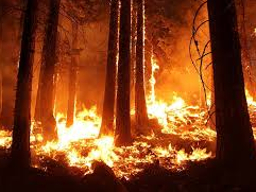
Instead of just burning off huge tracts of land and endangering all the local wildlife, today’s invention is to employ UAVs, each equipped with a camera and a small, gas-powered blowtorch. The downdraft from the rotors would be used to fan the flames in the desired direction.

This would allow a team of remotely located foresters to burn only smallish regions in advance of the firefront.

They could decide where to burn, based on feeding known wind behaviour into an agent based model. Running several simulations (perhaps on a parallel supercomputer) could be done faster than the fire could move, enabling some kind of optimal burn pattern to be calculated and then implemented.

#2725: Convectarget

When heat engines generate too much entropy, due to eg friction or uncontrolled heat transfer, they overheat.

This may not be a problem, unless the engine is powering a plane or a race car, where engine failure can have sudden and catastrophic consequences.

Fortunately, these days, we have relatively cheap access to thermographic cameras.

Today’s invention is a system which uses a number of cameras in say an engine bay. These detect any hotspots and then direct a cooling airflow (or oil/water…) at that location until the temperature can be shown to have evened out.

This airflow might come via a duct placed in a vehicle’s slipstream with vanes which could be computer controlled. If we had a space shuttle in operation, such a process could be applied to any overheating wing and fuselage surfaces.

#2724: BilledBoards

Google Street View is a huge endeavour. I’m surprised that no-one in Mountain View has yet come up with Today’s Invention: ads pasted into its imagery.

The intrepid search folk know all about which images are viewed most.

They could use this information to help price their virtual ads.

Say I want to have an advert for my patented corn plasters appear in virtual Times Square. That would cost me say $1000 a second.

I might choose instead to have the ad appear on the wall down the street from my house, at 1$ per day.

Online users might get served different inserted ads, depending on where their ip address was located.

In any case, people could pay for their version of Street view to carry no adverts, but if not, they could also click on virtual hoardings and buy stuff.

#2723: ShyDrive

When we find ourselves in the autonomous car-filled future, there will be many near misses.

Since these vehicles are likely to be battery powered, today’s invention is a way to make use of the massive torque available (beyond the potential for drag racing between the lights).

When a car senses that a collision is imminent, and steering out of trouble is not possible, then the vehicle can apply a sudden torque to the rear wheels and make the whole thing rear up out of the way -like a startled horse.

A flat back face allows the vehicle to park in that position until it can be safely rocked back onto its wheels.