#1372: ScreenKnocker

Knocking on a door in a unique temporal pattern may be used to tell the building occupants that someone they trust wants to come in.

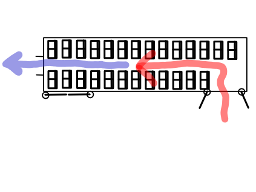
This is hardly the security of our cyber-era -or is it?

Today’s invention is a related alternative to the conventional secure login methods for a touchscreen-enabled device.

A user touches the screen anywhere in a certain temporal sequence. The machine can detect this and decide whether to log him in or issue a refusal. Either way, the touching can be done silently and in such a way as to be very hard to shoulder surf.

#1367: DisplayDiver

Inspired by seeing a stacking storage device for those families who have multiple tablet computers, today’s invention is an alternative to the ‘multiple workspaces’ desktop metaphor.

It takes the form of multiple desktops in depth. This might best be effected by using a depth-varying transparency, to allow lots of information to be displayed more effectively.

Via this, you can literally drill down into a screen of information, using a cookie-cutter type cursor. Lower layers may contain information which provides increasing detail about surface topics.

On a touch-screen, these lower layers of information could be accessed using a ‘gouging’ gesture.

#1366: RollReel

Sick of staring at those old plain-painted plaster walls?

Today’s invention is a networked projector which allows the user to download wallpaper patterns (and user-chosen combinations of sub-patterns) from a large database.

These are then colour-tweaked, according to taste, and projected onto one’s walls to give a realistic impression of the flock effect William Morris paper of your dreams -in situ.

Press the button and a selected number of rolls of personalised paper are in the post to you.

#1365: Lesstanding

Railways again. This time I’m interested in improving the use of space in carriages and the process of moving people about.

Passengers currently have to jostle to board through one of many side doors (after wondering where exactly those doors will end up). Instead, today’s invention is a train in which only the front and rear coaches open their doors when it halts (with door locations marked on the platform).

This allows people to leave, two by two, via one and enter via the other. The space around all the other (closed) doors would be filled with (~8*3) extra seats for the poor paying passengers to actually sit down on.

I’m sure the (parallel) boarding/ unboarding time would not be increased, since everyone would know which direction to move in, causing minimal turbulence.

In an emergency, even the closed doors would be flung open and people could climb out over the seats.

(The extra seats could be relocatable, in case a carriage was required to be used in front or rear position. Bicycles? Rent them at the station).

#1362: Panican

Have you ever had to break one of those alarm panels which are labeled “In the event of an emergency, break glass”?

Even those which are made of thin plexiglass and etched so as to crack especially easily make people think twice before activating them. In an emergency, that delay of even a few seconds, whilst one considers how to do the breaking and what damage your hand may sustain in the process, can be significant.

Today’s invention is therefore a reuse of the ring-pull can top, such as can be found on eg a tin full of chopped tomatoes. Instead of breaking any glass, the familiar ringpull would allow a metal disc to be easily removed, exposing an alarm button (or even using the broken seal itself as an electrical alarm switch).

People would be much more willing to pull the ring than smash a panel into fragments.

#1359: Pokair

Todays invention is a poker for wood-burning stoves, ovens and fireplaces.

Instead of just aerating the fuel by agitation and exposing fresh surface material, this device contains a replaceable cannister of compressed air in the handle.

When jostling the fire, a trigger on the poker can be pulled to inject a stream of air and thus stoke a reluctant fire more effectively.

#1354: LiftLess

Today’s invention is a way to improve the fitness of occupants of a skyscraper or tower block.

At, say, the seventh floor, the lift controls would only allow the lift to be called to travel to floors 9+ say and 4- to stop anyone using it to travel up or down only a small distance (buttons labelled 9,8,7,6,5 and 4 would simply be omitted or covered on that floor).

This would encourage people to make those small journeys via the stairs.

There would need to be a dedicated, keycard-access lift for disabled people in the building.

#1353: Hingebike

I’m always impressed by people who make working technology using junk.

Today’s invention is a bikeframe that can be built using a few planks and a hinge or two.

Three wooden triangles (blue and grey) made of planks, or whatever else is lying around, are bolted together and hinged where they meet (blue/grey interface).

You get some odd handling but your cerebellum will solve the dynamics problem quickly and your wallet will appreciate not having paid out £2k for the latest highly-stealable, magnesium/duralumin, hand forged sculpture from Cremola or whoever.

#1351: SeeCurity

People get cameras stolen all the time. Today’s invention is a security feature which attempts to make them useless to thieves.

Each digital camera would require that the first picture taken after switch-on was of the owner’s face. It’s relatively easy to make existing on-board face recognition work well when required to know one face reliably. (It might be possible to require snapping something else known only to the owner, such as a particular watch face or a page in a passport).

If the first picture is something else, then the camera would automatically shut down -making the theft of cameras pointless.