#59: Aural dialling feedback

Who knows what the global cost of mis-dialling phone numbers is.

Today’s invention is simply to equip handsets, both mobile and landline, with the ability to say, via speakerphone, the numbers you have keyed in (either digit by digit or after the whole number has been entered).

keypad109.jpg

My guess is that this would be significantly more effective than squinting at a small screen to check your dexterity.

A possibly useful extra service, for for those of us calling lots of unfamiliar numbers, might be to speak the name of the (directory-listed) person or company you are about to call.

If, despite all these measures, you still dialled a wrong number, the phone could be configured to allow you to record this manually and then extract statistics about what sorts of errors/ substitutions you habitually make. It could then take extra care to alert you to these in future before pressing the call button.

#58: Un-brella

Where would the poor old Patent Office be without the umbrella?

I’ve been thinking about how best to upgrade the humble brolly. Here are some suggestions.

brolly108.jpg

Replace all that folding framework over one’s head with a set of equispaced, flexible petals attached to the top of the shaft. The petals rotate like a propeller, fast enough to stop raindrops getting through to you. Flexible petals don’t poke people’s eyes out and merely brush by obstacles (like those little desk fans).

The whole shebang can be driven by a cordless drill motor (aerofoil-section petals might then help support the weight).

If you want to get really funky (my recommendation), then drive it using a toothed belt attached to one’s foot. The belt would engage with a ratchet on a flywheel in the handle of the brolly only as your foot moves downwards; slipping over the ratchet freely as your foot rises again.

All this gyroscopic rotation would help stabilise the unbrella against gusts of wind but might make cornering complicated.

If you must, the petals can be decorated with slogans which are only visible when spinning.

When the rain stops, the motor can be disconnected and the limp petals easily wrapped around the shaft using an elastic band (Patent number: US 1000299278387467837687282827128918 “Linearly Extensible Continuous Ring-shaped Securing Device or System”).

#57: Less lees

I remember once reading that various foodstuffs manufacturers only make a profit because people routinely fail to extract the last few drops of produce from the container. It’s particularly true of viscous fluids like mayonnaise, tomato ketchup, mustard etc but it might apply equally to higher value produce -especially shampoo/conditioner and related cosmetics.

My invention today is simply to repurpose the old magnetic stirrer device (or perhaps the magnetic window cleaner) in order to speed the evacuation of the bottle concerned. Obviously, it still makes sense to invert the container so that gravity can assist, but life’s too short to ensure that all the contents eventually come out -especially when sandwich urgency has set in.

viscous105.jpg

Each household could have several PTFE-coated magnetic beans (colour-coded to avoid getting shampoo in the honey). They could all be driven by a single powerful, handheld rotating magnet unit.

It might be useful to induce some eddy currents in the bean in order to warm it slightly and reduce viscosity. Even without spinning magnets, rolling a spherical ‘bean’ up and down inside the container, using an external magnet, would be a good way to ‘spoon’ out any residue…especially for bottles with complex internal shapes (these might be supplied each with a captive, rolling bean). This technique would also be useful for clearing out coffee grounds and other hard-to-get-at stuff.

#56: One battery size to rule them all

I’m sick of scouring my entire household for the right number of the right size batteries with the correct charging characteristics. I always seem to have one too few of whatever I need…usually I have one too few even to get the damn charger working.

Today’s invention is simply to replace all the D/R20, C/R14, AA/R6, 9V/6F22, AAA/R03 nightmare with a single, standard battery size. My first choice would be to replace all these ridiculous products with variable-size stacks of one type of existing watch battery. Small, standard modules building to provide flexibly-sized systems seems to be a good idea in general. I could then keep a sack of the batteries somewhere and always be sure that I could drop in the right number for whatever device was suddenly in demand.

batteries104.jpg

OK, I know that the standard watch batteries aren’t easily rechargeable and that their sizes may not add up to be an exact fit for existing compartments and that their outputs may not quite match the requirements of all devices and that some legislative body would have to certify their use in case they somehow triggered a nuclear accident -but I’m also quite sure that these aren’t showstoppers, they just need a bit more technical ingenuity in return for an enormous amount of extra flexibility.

Everyone is waiting for the advent of a novel battery technology which will allow their latest gadget to stay awake for longer. At least with the standard-size idea it would be a lot easier to carry several small replacements and slot these in when necessary.

#55: Shame-cards

Both local and nationally famous photographers are invited to contribute images to the following scheme.

In an attempt to name and shame our ‘representatives’ in government, images of the less attractive aspects of life should be made available as ecards in order to provoke those responsible into doing something (other than whingeing about ‘lack of resources.’)

rubbish100.jpg

If you have a local planning issue, an eyesore such as unrestrained street advertising, uncollected rubbish, speeding traffic or public property that lies forever unrepaired, send an image to the shamecard website together with a description and the relevant postcode. This will be automatically dated and published with the names of all the officials who have failed to fix it (from local councillor to MP level).

I’d also suggest that their salaries (+allowances) be added to this information at the same time.

All of those responsible will automatically be sent a copy of the card in question (as will a range of both online and offline picture editors).

#54: Resisting retail entropy

You need a certain determination to buy small items such as screws and nails at your local DIY store these days.

When hunting for some of those crucial widgets, you can find yourself wrist deep in troughs of staples in packets, loose washers, odd nuts and bolts.

nails99.jpg

Everything ends up in the wrong place as people rummage around, pick up items and, fearing they can never be found again in the detritus, carry them until they find a better fit for what they actually need -at which point, they drop the unwanted items wherever is convenient.

Needless to say, the staff in these places don’t know a brace from a bradawl so they tend not to bother with reorganising the debris that their customers have created. Today’s invention is an attempt to minimise these difficulties by suggesting some refinements to the display environment.

For items in packets, use gravity dispensers: when one packet is pulled from an aperture, the next falls into the bottom position, ready for extraction.

Array these dispensers on a 2-D display unit in order of the size and/or material of the content -so customers can tell know roughly where to start looking.

Provide a lifesize photo of the content and relevant information on the outside of each dispenser (No need to include store catalogue numbers or extraneous detail such as the standards to which components have been tested -it’s confusing and slows the whole thing down. Just watch how many people have to stop to get their glasses on to read the small print.)

Ensure the dispensers have a lockable inlet at the top so that customers can’t re insert the wrong items in a dispenser.

Ensure there are no horizontal surfaces within arm’s reach on which items or packets can be left by people who inspect them and then choose not to buy. This introduces a disincentive for customers to extract product without thinking about it first and may encourage them to buy whatever they have in their hand. A single, large hopper could be provided, suitably signposted, into which any such items could be dropped for later, manual reinsertion into the correct dispensers by staff. People are generally reluctant just to drop stuff on an otherwise tidy floor. Analysis of the content of these hoppers of spurned items could also yield extra insights into customer preferences.

    #53: Biscuit freshness measure

    Making biscuits for a living is surprisingly hard work. One of the important isssues is how long will the product stay fresh, whether in a sealed packet on a supermarket shelf or once the packet has been opened.

    Here’s a way for manufacturers to quantify the freshness of their product as a function of time, humidity, sugar content or whatever.

    biscuit96.jpg

    It’s well known that the one’s eyeballs vibrate, when crunching food, in ways that the visual system itself can’t compensate for. This effect is made visible when eating a biscuit in front of your computer monitor (generally bad for the keyboard).

    The screen image will appear to jump around with an amplitude and frequency largely determined by the crunchiness of the food and the frame rate of the monitor (similar things happen to horn players apparently…Horn players who eat biscuits simultaneously are an endangered species).

    #52: Market mathematics

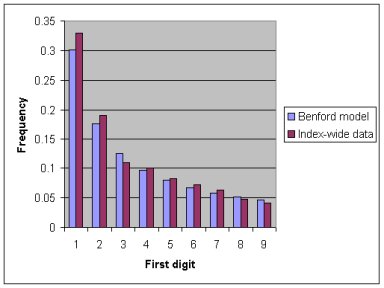
    Benford’s Law states that the digits making up numbers in large datasets occur with frequencies which follow a simple pattern and can therefore be predicted. This only applies if the numbers are unrestricted in terms of the range of their values (which certainly applies to stocks…think Wall Street Crash). Numbers beginning with a 1, for example, will occur about 30% of the time.

    Today’s idea is to use this phenomenon to get a small edge in stock trading. Specifically, if you are trying to predict movements in an Index as a whole.

    benford93.jpg

    If all the stock prices in a given market are analysed, the frequency of numbers with different first (ie most significant) digits can be graphed (in purple). These columns can be expected to follow Benford’s law (blue). Here we see that values with 1 as first digit can be expected to be just about to decrease in frequency, whilst those with first digit 8 are can be expected expected to become more common.

    A simple sum of the positive and negative deviations from the Benford distribution will indicate whether the index is set to rise or fall.

    Applying this technique on eg a daily basis, for a long time, seems to me to provide an edge, which might well be significant compared to the various sources of noise in the system. It’s also likely however to result in large short-term losses which may make the scheme unworkable for anyone other than a very rich gambling addict (As Richard Branson says “How do you become a millionaire? Become a Billionaire and start an airline”).

    #51: Colour blindness correction

    Having recently heard about someone who was refused a place at medical school due only to his colour blindness, I began thinking of ways to help those of us with an impoverished ability to distinguish between eg shades of red and green (which affects hue discrimination in 5% of all males).

    Rather than use (expensive) coloured contact lenses, simply equip colour blind people with a bright pencil torch, over which is fitted a coloured filter. For red/green deficit, the filter could be red so that when viewing a scene containing both red and green items, the red ones would stand out more brightly. The torch could be incorporated into eg spectacle frames for added discretion and also for driving (who thought that making traffic lights red and green was a good idea?)

    These days it is possible, given some clever correction for background lighting, to undertake analysis of a digitised scene and to create an ‘augmented reality’ by applying eg a sparkly texture to regions which a normally sighted person would describe as ‘red’. Even a crude version of this, which was able to detect any red and green patches lying close enough together in a scene, could be used to provide an alert.

    #50: Paparazzi dazzler

    It’s tough being a celebrity, I understand. Even C-list ‘personalities’ are pursued for their photograph these days in the economic war to feed people their daily tabloid fix.

    For those females in the public eye who’d rather not make several £k per shot for press photographers, here’s a simple device to bring a scowl to any picture editor’s countenance.

    earrings86.jpg

    Earrings that project a moving pattern of intense, coloured light patches on their wearer’s face. These could be constructed from LEDs and the swirling patterns generated by small, spring-mounted mirrors amplifying the wearer’s natural body motion (or driven by bluetooth signal from a Blackberry in the handbag -or even vibrated by sound from an earpiece). They might activate automatically in response to the whine of a warming flash, a motordrive, an IR autofocus beam -or just the baying of the snappers themselves.

    This would make taking a recognisable photo almost impossible, even for the most determined paparazzo with a flash gun set to stun.