Archive for: March 2010
March 21, 2010
Mobile phones typically have 8+ megapixel cameras built in.
Rather than have to raise these to one’s face, I’d like to be able to just record what I see. Today’s invention therefore is to mount one such camera in the frame of some spectacles.
The rest of the electronics, including power supply, could be held on a pocket unit which would also accommodate a remote shutter release.
When you want a record of whatever you are looking at, simply stare at it and press the button.
I sometimes see young men who have been facially disfigured in a brawl with someone using a broken bottle or glass. This is a problem significant enough for pint glasses themselves to have been redesigned.
Today’s invention is a simple device to be used in pubs. Before a bottle is de-capped and handed to a customer, the bartender inserts it into a circular aperture and turns it through 360 degrees.
This aperture contains a small diamond glass cutter which scores around the neck of any bottle, 30mm from the cap.
It’s exceptionally difficult to break any bottle cleanly, so the effect that this scoring will have is that the bottle, held by the neck, will snap, when it is struck on a table top to make a weapon, in such a way that the potential attacker is left holding a very short, painfully jagged piece of glass.
Not only is this hard to hold and therefore pretty useless as a weapon, it also makes them look rather ridiculous.
March 17, 2010
There is an entire industry devoted to helping people get the tops off jars.
Today’s invention is another such kitchen device. It consists of a thin square of recyclable plastic material with a strong sticky pad on one side.
This is perforated along a wiggly line so the user can break it into two pieces. One is pressed and stuck to the jar cap as shown, the other is attached to the jar bottom. The fingers protruding on one side of the jar allow for a massively improved grip -even for those with dexterity or finger strength difficulties.
The pads stay in place and don’t affect the glass recycling process much more than the labels on the jar.
Today’s invention reinvents the wheel…again. It started by thinking about how animals like the cheetah move at speed by flinging back legs forward over front legs which are gripping the ground -even very rough ground.
A vehicle (blue) is fitted with a large number of axles. Each has a cylindrical sleeve on both ends which rotate with the axle. In the sleeve, a ‘leg’ is located, so that it can be driven axially within the sleeve (perhaps by use of a screw thread driven by a motor on each axle).
The vehicle would have many wheels operating in sequence, as shown -allowing the overlapping legs to reach forward, grip the ground, push backwards and then be withdrawn axially (or rotated) for a new cycle.
This would allow rapid cross-country movement, potentially with no vertical motion of the vehicle body.
March 16, 2010
Today’s invention is a new form of tyre which can be changed without removing any wheels and jacking up a couple of tonnes of steel.
It is in the form of a number of rubber compartments, each with a metal foot bonded on. These feet are slotted axially into a hub, as show, by slightly deflating the adjacent segments using the valve which each incorporates.
Repressurisation allows the whole tyre to be used rapidly…there is no longer any need to carry a giant spare tyre…a couple of extra segments should suffice.
March 14, 2010
Parents these days are often unhappy about equipping their progeny with ‘war toys.’
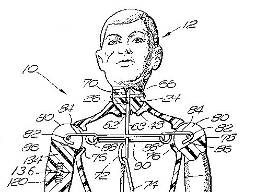
I used to love playing with Action Man (or GI Joe as the original patent specified). Today’s invention is a new version of this old favourite with a slightly more moral approach.
This takes the form of a figure fitted with a wii-like accelerometer and a microphone. If the figure is subject to too much noise for too long, some of his joints are automatically loosened (using a battery-powered, geared internal motor which withdraws the screws holding limbs in place).
After a ‘recovery period’, the joint friction is restored by reversal of the motor.
Excessive noise and impacts would result in limbs becoming fully and irrevocably detached, thus illustrating that even legendary warriors are not invulnerable.
A range of scale equipment, specifically aimed at rehabilitating such wounded servicemen, would also be on sale.
March 13, 2010
Abstract paintings can be fun, but let’s not pretend it’s art (ie ‘something designed to communicate an emotional state’). No, it’s decor.
Today’s invention is a picture frame which contains an old-style acoustic burglar alarm, wired to a small motor. The frame can accommodate any abstract work of your choice.
A few random times a day, if the sensor detects that no-one is in the room, the motor rotates the picture quickly through a random multiple of 90degrees, giving the owner more visual variety and an added talking point.
The web is full of sites which provide a shopping function like this, in which a chosen region of a product image can be shown in close-up.
So, the bits people look at can be used as a way to discern what they want to buy. If they pay attention to the fur collar, the zip, the pricetag, that tells you something about their interests. Whether they buy or not, you get a wealth of information about their priorities.
Today’s invention is a tool which simply monitors the close-up window’s placement sequence and spots patterns which enable enhanced product development decisions. If a number of people leave the page without buying, having just seen the details of the leather grain, you know something needs fixing.
The tool would also do some tricks like issuing messages such as ‘was it the [leather]? Maybe look at these items instead…’ It might even be possible to offer realtime, personalised discounts: ‘Maybe it’s not exactly what you were looking for -so how about 5% off?’
March 12, 2010
Today’s invention is another tool to help improve the handwashing of hospital medics (a New York Times article recently claimed that washing only happens about 1/3 as frequently as training requires).
All medical staff in contact with patients would wear a brightly coloured bracelet. This would contain an aerosol full of harmless, water soluble paint.
The bracelet would also contain a timer which would ensure that a small spot of bright paint was delivered onto the back of a medic’s hand, say every ten minutes throughout the day.
Appearance of the paint would remind wearers to wash their hands at once. Patients could raise an objection if either the bracelet wasn’t worn or there was a spot of paint on the hand of their examiner.
March 11, 2010
I’m contemplating getting aloft using a paramotor. If the main ‘glider’ (sail-type parachute) fails, one is ordinarily equipped with a reserve chute, but this is of little use at operational flying levels of ~200m.
Today’s invention is therefore a paramotor fan which can tilt from a horizontal axis to a vertical one, when the pilot realises that a crash landing is imminent. It would automatically jettison the glider canopy once the decision to use the motor in this way was made.
Although the fan could never support a pilot’s weight on its own, it could, in an emergency, greatly reduce the rate of descent, especially if driven at an almost self-destructive speed in this last-ditch mode.
« Newer posts — Older posts »
|