Archive for: March 2009
March 22, 2009
I tend to smile when reading about USB-powered fans by which the users of laptops can cool their fevered brows whilst typing in transit. My problem is different. Travelling by rail in Scotland, the carriages are routinely unheated…making my attempts at hunt-and-peck even more laboured.
Typing whilst wearing polartec gloves is even less accurate than usual, so today’s invention offers a new approach.
The fan outlets from one’s laptop are fed directly into a light plastic pipe. This is connected at the other end to a transparent canopy which is held in place a few centimeters above the surface of the keyboard (sloping downwards slightly towards the screen for improved visibility -transparent to allow we non-touchtypers to watch our hands).
Hot air from the machine is thus played upon one’s digits; allowing keyboard use to continue en route to Siberia (or Glasgow Queen Street) and at no extra cost (economic or environmental).
March 20, 2009
I believe that a postmistress somewhere in an English village has begun writing the names of the children who buy crisps and drinks from her on the packaging. This allows her to identify any litter and to ban the miscreant youngster responsible from her shop in future.
For sellers who don’t know their customers personally, the problem of litter usually goes unaddressed.
Today’s invention is a vending machine which takes only notes as payment. Each item on sale is printed with a machine-readable code. People who buy from the machine, only receive their change if they place the ‘empty’ in the tray provided. If they choose to throw their litter around, other people can get their change.
The machines might be networked together so that it would be possible to dump an empty can in a different machine to the one from which it was bought and still get the correct change.
I’m told, by a biologically inclined friend, that many medicines work at certain times of day and are largely ineffective at others. Having to take tiny amounts of pharmaceuticals at precisely timed intervals is not an easy regime to adopt. Today’s invention offers an alternative.
A container, in the shape of a large pill, contains a variety of drug material, a small iron core, a dispenser and an electronic timer. The pill would obviously need to be coated in a biocompatible material.
Once swallowed, a user would attract the pill to the wall of their stomach, using a strong external magnet. When it was in place, turning the magnet would cause a suction cup on the pill’s outer surface to attach itself to the inside of the stomach.
The electronic timer would dispense the right drugs at the right times and then release the suction cup, allowing the pill to be excreted (and reused if necessary).
Now that smoking is outlawed in public places, it’s time to do something about the trash which smokers feel it’s ok to jettison in their wake. The crowds which gather outside foyers seem frequently to ditch their stubs and packets for the rest of us to walk through.
Today’s invention is a vending machine which allows smoking but which retains all the associated detritis.
Users would select a cigarette brand from an illuminated panel and make their payment. Each would then be allowed to unroll a length of hose with a crimped end forming a mouthpiece. A cigarette would be lit within the machine and the smoke pumped from inside to the smoker.
When they were finished, the hose would be withdrawn automatically, cut off and binned for recycling.
The vending machine could support several smokers simultaneously and might be located within a shelter with a fan in the roof in order to retain the exhaust fumes.
Today’s invention is an attempt to help limit consumer spending on credit (sorry economists/bankers, but I still think that’s a bad thing).
People using their mobile phones as payment devices would, before clicking ‘buy,’ be shown a photograph on screen portraying the exact amount of money in their account before and after the transaction (in £5 notes and coins).
This would make the implication of their planned action transparent and perhaps delay it enough to allow for second thoughts.
The ‘after’ photograph of a purchase which involved becoming overdrawn might be the user’s photograph suitably reddened automatically to look embarrassed.
March 17, 2009
Generally, I’m against any form of subliminal advertising, but today’s invention applies this idea in a good cause.
A subset of several, big-name glossy magazines would be specially printed to contain a few, subtly-added extra pages.
These would carry stories designed to promote a healthier lifestyle and be reserved exclusively for use in medical waiting rooms.
Ideally, the venture would be funded by extra adverts for e.g. exercise machines and activity holidays. Being much more current than average waiting room reading material, these would receive preferential attention.
As we’ve seen recently in Australia, when a railway line gets really hot, the thermal distortion can be severe and result in permanent damage to the track. Similarly, in cold conditions, lengths of welded track can pull themselves apart, due to contraction. Such sections are commonly inspected on foot, when the weather is severe.
Today’s invention is a mechanism to limit the potential damage to railway track in extreme conditions.
A very small, light cart runs with its center of mass barely above the level of the track. This is semi-autonomous and travels at over 100mph. The cart contains:
temperature sensing equipment capable of detecting an unhealthy rail temperature
a set of pads which can be pressed to the track like brakes to generate frictional heating, if necessary
a pair of air scoops which can direct a high-speed airflow onto the tracks to help reduce their temperature.
The cart will oscillate over considerable distances, changing the temperature a little at each transit. When a train needs to get past, it will automatically rotate off the track and then replace itself again. Many of these cheap units might operate in concert, together maintaining a great length of track.
March 15, 2009
According to the Economist “on hearing a fire alarm many people do absolutely nothing. It is only when they see direct evidence of a fire, such as smoke or flames, that they act”.
Today’s invention is therefore an adaptation to existing alarms. Fire alarm testing would take place entirely as normal, but in the event that an alarm was activated, all of the other alarms in a building would emit a small burst of non-toxic, smoke-like material.
This would be in such small quantities that escape routes would not be obscured but occupants would be made aware of the urgent need to evacuate…and stimulated at a primal level to achieve this.
There might even be scope for illuminating each smoke cloud with a flame-like flickering light, shone from a lamp within the alarm housing.
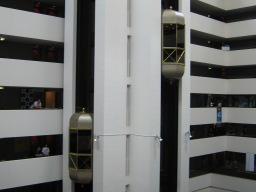
Lifts in tall buildings tend to be very energy efficient. This is because the design involves installing massive counterweights which move downwards when a lift compartment is moving upwards.
Today’s invention involves replacing the counterweight with another lift. Joined by a cable, the itinerary of one lift would therefore be the complement of the other ie in a 100 floor building, lift 1: 1->2->4->60 lift 2: 99->98->96->40.
These rolling itineraries would be displayed near each lift door so that people would have an extra choice of waiting for the next one moving in their preferred direction or grabbing the additional lift.
An even smarter system would allow travellers to enter their destination floor at the keypad and then calculate what their best option was (possibly also taking into account the widespread psychological preference for moving, anywhere, rather than waiting -and also the possibility of approximation: taking the lift to within a stair-walkable distance of their target floor).
Everyone makes purchases which are strongly influenced by something called branding…the values associated with a product that go beyond the thing you’re nominally paying for. Trademarks are one long-established way for product makers to protect the investment they have made in developing their brand.
Trademarks have a commercial value…today’s invention is a way to quantify this.
Images of products, with their normal trademarks and badges attached, would be displayed via a website to a given, statistically representative, audience (within some chosen demographic group). The same products would then be shown to a different audience but having had all such identifiers digitally airbrushed out.
People would be asked to identify, by multiple-choice box ticking, which brand corresponded to which product (the trial could be made into a contest in order to attract sufficient interest to be meaningful). The results would be compared between the two groups to determine which trademarks were most recognised and therefore valuable.
This could be extended to tests in which the wrong marks were applied to products (eg a Jaguar badge digitally applied to a Ford car…would people notice the mismatch? Does rebadging really transfer brand values?)
« Newer posts — Older posts »
|